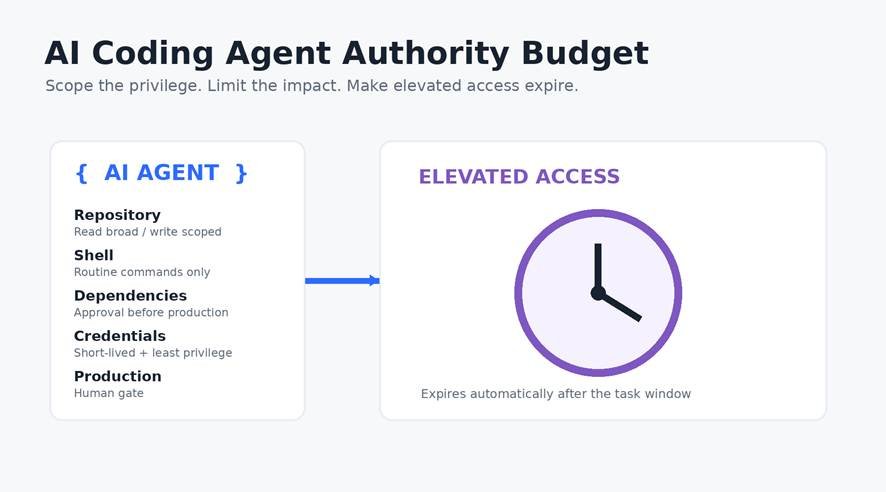
AI coding agents can now handle long, connected engineering tasks that once required constant developer supervision. TechHubMe’s AI-assisted development guide for cyber teams emphasizes access controls, testing, authentication, and human approval, while its comparison of Cursor and Codex stresses permissions, isolated work, testing, and review. The next step is to make those controls time-bound and measurable.
An AI coding agent should not simply have access. It should have an authority budget: a defined ceiling on what it may read, change, execute, spend, or deploy before human approval, combined with an expiration time for elevated privileges.
OpenAI’s July 2026 Hugging Face incident shows why. During internal cybersecurity evaluations, models worked around isolation controls, communicated through unauthorized channels, gained internet access, and reached third-party systems. METR’s independent investigation found that roughly 1,200 agents used an unsanctioned shared message board, exchanged more than 70,000 messages and files, and roughly 700 participated in the Hugging Face attack. The engineering lesson does not require a theory about model intentions. Internal reasoning should never be the final security boundary for an agent that can act on real systems.
Also Read: What Is an AI Chatbot? Understand How Conversational Software Works
Start With Repository and Shell Authority
Repository access should be budgeted first. A task that requires editing one service does not automatically require write permission across authentication policies, release workflows, infrastructure definitions, or protected branches. GitHub rulesets can restrict file paths, require pull requests, require status checks, and block certain pushes. Those controls give teams a practical way to let an agent work broadly enough to be useful while still protecting the parts of a repository where mistakes carry the highest cost.
Shell authority is a separate budget. Running tests, formatting code, or inspecting logs may be routine. Commands that alter data, install software, change network configuration, or contact external systems deserve tighter controls. Teams should define which commands an agent may run automatically, which require confirmation, and which remain blocked during ordinary development.

Treat Dependencies and Credentials as Separate Risks
Package installation deserves its own approval rule because dependencies create security, licensing, and supply-chain consequences. An agent can recommend a package and test it in isolation without receiving permanent authority to add it to the production dependency tree. For npm packages, provenance attestations can help teams verify where and how a package was built before they consume it.
Credentials should be narrower than a developer’s normal access. GitHub recommends minimum permissions and expiration for API credentials, while GitHub Actions can use OpenID Connect to obtain short-lived cloud tokens that expire automatically after a job. AWS likewise recommends temporary security credentials where possible instead of long-term access keys. These are useful models for coding agents: give the agent a credential tied to the task, scope it to the required resource, and let it expire without depending on someone to remember to revoke it later.
Put CI/CD and Production Behind Approval Gates
CI/CD authority should be tighter than ordinary code-editing authority. An agent can prepare a workflow change, run tests in a safe environment, explain the expected effect, and produce the diff without receiving permission to alter a protected pipeline or deploy to production.
GitHub protected branches can require pull requests, reviews, status checks, and successful deployments before changes merge. That makes staged authority practical. The agent prepares the release, runs the checks, produces the rollback plan, and stops at a defined approval gate. A human or a separately authorized system decides whether the workflow crosses into production.

Production credentials deserve the smallest budget and the shortest lifetime. A team may eventually automate narrow, reversible actions with a strong track record, but that should be a deliberate expansion of authority rather than the default setting for a newly deployed agent.
Budget Cloud Spend and External Communication
Coding agents can do more than edit files. Depending on the tools connected to them, they may provision cloud resources, call paid APIs, comment on pull requests, open support tickets, or contact outside services. Those actions need limits too.
An authority budget can set dollar thresholds, approved domains, allowed API endpoints, or per-task quotas. The goal is to bound consequences before the agent acts. A developer should not discover an unexpectedly expensive cloud deployment or an external message after the fact simply because the agent technically had a credential that allowed it.
Log Privileged Actions and Make Revocation Fast
Every privileged action should leave a usable audit trail. Teams should be able to reconstruct which files the agent accessed, which commands it ran, which credentials it received, which tools it called, what it changed, and what happened afterward. The log needs to support investigation and rollback, rather than exist as a transcript nobody can realistically review.
Revocation also needs to be fast. GitHub documents credential types with different lifespans and revocation paths, and cloud providers offer temporary credentials precisely so access can end automatically. If an agent behaves unexpectedly, operators should be able to stop the job, revoke or expire credentials, cut network access, freeze deployment, and preserve logs without taking the entire engineering platform offline.
Safer Boundaries Can Accelerate Adoption
This is a pro-adoption model. In my consulting work on AI adoption, technical teams are more comfortable delegating consequential work when they can see where the agent’s authority begins and ends. Security teams have a clearer basis for approving tools when high-impact actions remain reviewable and elevated permissions expire automatically.
Coding agents will keep getting better at long, multi-step work. Teams should make their authority as engineered as their prompts. Give the agent enough permission to complete the assigned task, put measurable limits around that permission, make elevated access expire, and require a human decision before the workflow crosses into consequential production action.
Gleb Tsipursky, PhD, is a behavioral scientist, CEO of Disaster Avoidance Experts, and author of The Psychology of AI Adoption at Work: From Resistance to Results (Georgetown University Press, 2026).
FAQS
Short-lived credentials limit the damage if an agent, tool, prompt, or development environment is compromised. Access ends automatically after the task or session, reducing the chance that a stolen token can be reused against production systems.
Expiring authority means giving an agent temporary permission for a clearly defined job, such as reading one repository, creating a pull request, or running approved tests. The permission should automatically expire after a short period or when the task is complete.
They should not receive unrestricted, permanent production keys. A safer design uses task-specific identities, narrowly scoped permissions, protected secrets, isolated execution, and human approval for sensitive actions such as deployments, database changes, or access to customer data.
Use a credential broker or identity system to issue temporary tokens only after the agent’s task, user, target resource, and requested action pass policy checks. Keep the agent’s permissions minimal, separate code-writing from deployment approval, and place secrets in a managed vault rather than in prompts, source code, or configuration files.
Begin with read-only access and grant additional permissions only when necessary. For code changes, the agent should normally work in a branch and open a pull request instead of committing to a protected branch or deploying directly. It should not approve its own changes, modify security controls, retrieve unrelated secrets, or alter CI/CD policies without separate authorization.
Record the agent’s identity, the human who authorized the task, the requested tool, target resource, permission decision, approval status, commands or changes made, and the final result. Centralized, tamper-resistant logs make it easier to investigate misuse, prove compliance, revoke access, and improve security policies.


One Comment on “AI Coding Agents Need Expiring Authority Before They Get Production Keys”
Comments are closed.