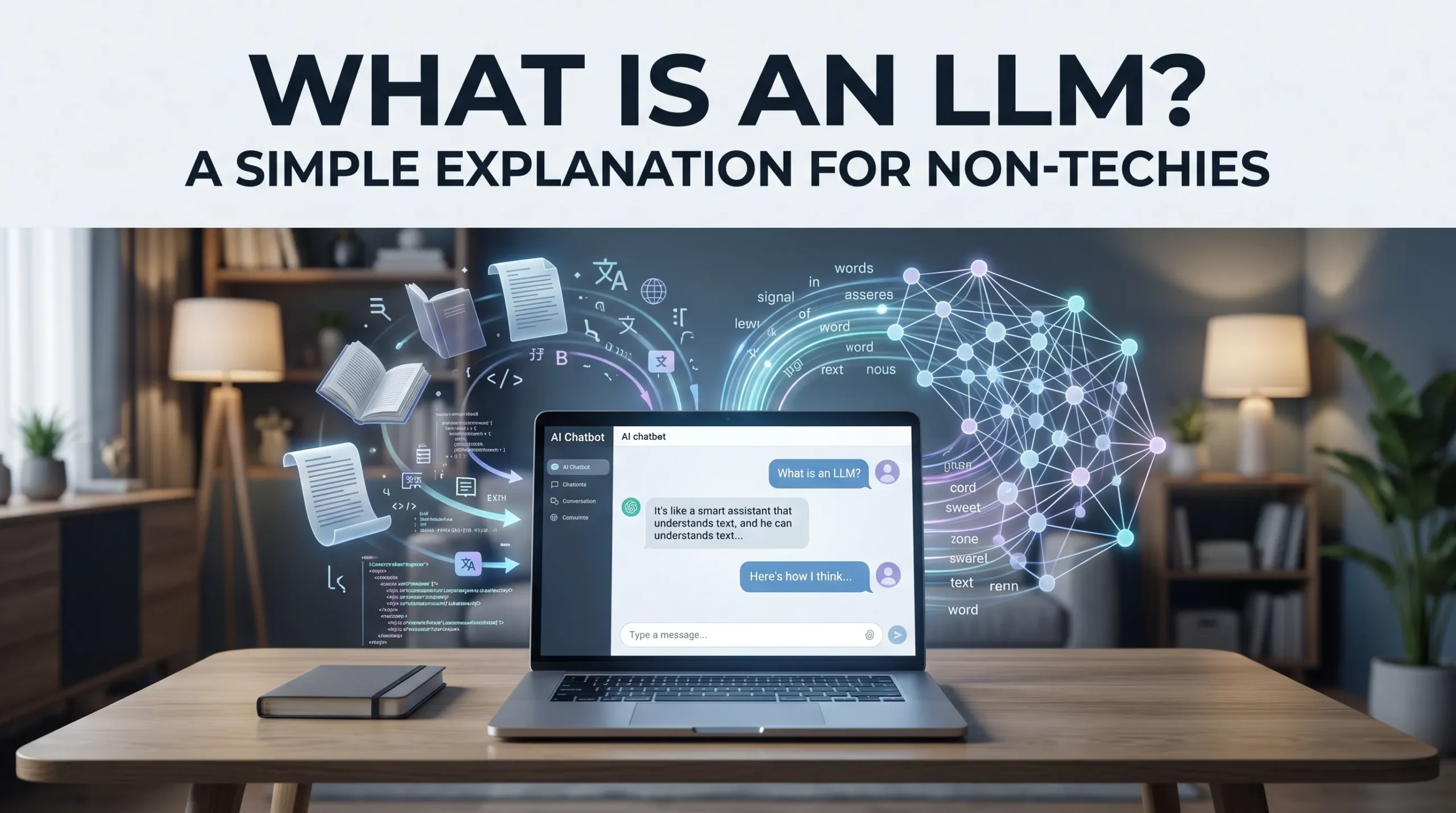
You ask a chatbot to explain a confusing bill, draft a polite email, or summarize a long report. The answer arrives in seconds and sounds natural. That raises a fair question: what is an LLM, and how can software write so much like a person?
An LLM, or large language model, is software trained to spot patterns in language and generate text in response to instructions. It can help with many everyday tasks, but it doesn’t think, feel, or understand the world as people do.
Also Read: AI Coding Agents Need Expiring Authority Before They Get Production Keys
What Is an LLM? The Language-Prediction Basics

What “large language model” means
“Large” refers to the scale of the model and the amount of data used to train it. “Language” means the model works with text, such as questions, stories, and code. A “model” is a computer system that learns patterns from examples and uses them to make predictions.
Large language models can pick up patterns in word use, sentence structure, and how ideas often connect. They use those patterns to respond to a prompt. IBM describes LLMs as systems that repeatedly predict what text should come next.
Also Read: Claude vs Chatgpt vs Gemini : Which Is Better for You?
How an LLM differs from a chatbot
An LLM is the technology working behind the scenes. A chatbot is one way to interact with it, usually through a chat window where you type a question and read the reply. Some chatbots use LLMs, while others rely on simpler rules or scripts.
LLMs can also power writing tools, coding assistants, search features, and customer support systems. The same model may sit behind different products, each with its own design and features. So “LLM” names the engine, while “chatbot” describes one kind of interface.
Also Read: What Is an AI Chatbot? Understand How Conversational Software Works
Why fluent answers can seem human
An LLM learns which words and ideas often appear together. That helps it produce sentences that fit the prompt and sound natural. A smooth answer, though, doesn’t show that the model has feelings, memories, or personal experience.
The model builds its reply from learned patterns, not from a human point of view. It can describe grief without feeling grief, or explain a trip without having traveled. Its writing may sound sure of itself even when its facts are wrong.
How an LLM Learns Language Patterns
How training teaches a model to predict text
During training, a model practices predicting missing or next words in many text examples. It compares its guesses with the text that follows, then adjusts internal settings to improve future predictions. This process happens repeatedly across the training material.
When you ask a question, the model uses your prompt and the words it has already generated to predict what comes next. It builds the answer piece by piece, rather than writing the whole response at once. The IBM overview of LLMs explains this prediction process in more detail.
What “tokens” and “parameters” mean
Models don’t always process text as whole words. They split it into tokens, which can be full words, parts of words, or other short text units. For example, a long or uncommon word might be handled as several chunks.
Parameters are adjustable values the model learns during training. They help shape how it uses patterns to predict text. As one scale example, the GPT-3 paper by Brown and coauthors reported a model with 175 billion parameters.
What training data can—and cannot—teach
Training data can help a model learn language patterns and information found in its examples. The model may also reflect errors or gaps in those examples. Training alone doesn’t guarantee that every response will be accurate, complete, or up to date.
A model’s answer also isn’t automatically tied to a source you can check. Some tools can look up outside information while responding, but that depends on the product. Even then, you should check important claims against reliable material.
How an LLM Uses Prompts to Generate Answers

How a prompt shapes the answer
A prompt is the question, instruction, or background information you give the model. A clear prompt helps the model focus on your goal. For instance, “Explain this lease clause in plain language for a first-time renter” gives more direction than “Explain this.”
You can also ask for a certain format, such as a short email, a table, or a few key points. Useful background helps too, as long as it’s relevant and safe to share. The details you provide can change the answer.
Also Read: Claude Code vs GitHub Copilot: Choose the Right Tool for Your Workflow
How the model generates a reply
The model reads the prompt, predicts a likely next token, then repeats the process using the text it has already produced. That is how it forms a sentence and then a full response. Settings and product features can affect how it chooses among possible next tokens.
A reply can change if you phrase the same request in a different way. That doesn’t mean one wording always guarantees a better answer. It means the prompt is part of the context the model uses to make its predictions.
How to write prompts that get better results
Start by stating what you want done. Add only the background the model needs, name the intended audience, and specify the format or length. If the first result misses the mark, ask for a focused change, such as “make this warmer” or “cut it to 100 words.”
Treat privacy with care. A tool’s rules for storing or using your input may differ, so check its data practices before sharing personal, medical, financial, or business details. You can often remove names or other identifying details first.
What LLMs Can Do in Everyday Life
Use an LLM to draft, rewrite, or brainstorm
You can ask an LLM for a first draft of a routine email, a clearer version of a paragraph, or ideas for a presentation. It can also change the tone of a message, such as making it more direct or more friendly. These tasks give you a starting point, not a finished piece.
Read the result before using it. Check that it says what you mean, then add your own details and voice. A polished draft can still include a wrong name, an awkward phrase, or a claim that needs checking.
Use an LLM to summarize or explain
If a term in a work document feels unclear, ask for a plain-language explanation. You can also provide a report and request a short summary of its main points. The answer may save time when you need an initial sense of a long text.
For important details, compare the summary with the original. A short version may leave out a key limit, exception, or warning. Don’t rely on a summary alone when a small detail could change what the document means.
Use an LLM to translate or organize information
An LLM can translate a short passage, turn rough notes into a checklist, or sort information into categories. These jobs can be handy when you need a quick first pass. The results may vary, especially when wording depends on culture, specialist terms, or subtle meaning.
For anything formal or high-stakes, have a qualified person review the result. A translation that reads smoothly may still miss a tone or phrase that matters. The same goes for organized notes: check that nothing important was left out.
Why LLMs Can Make Confident Mistakes

Why an LLM may produce incorrect information
Fluent writing is not proof that a claim is true. A model can produce a plausible-sounding detail that is false, unsupported, or invented. This is often called a “hallucination,” though it isn’t a deliberate lie: the model isn’t choosing to deceive you.
An OpenAI explanation of language-model hallucinations describes how a model can give a confident answer that isn’t true. When a model lacks enough reliable information, it may still generate a likely-sounding response rather than stop.
Also Read: Cursor vs Codex: Which Is Better for Faster, Safer Coding?
Why answers may be incomplete or out of date
A model’s information can be limited by its training data, product design, or access to current sources. It may not know about a recent change or a new event. Even a detailed answer can miss context that matters to your question.
Some products can retrieve current information from outside sources. If yours does, check the source and its date rather than relying on the answer alone. A link or citation should lead to a source that supports the claim.
How to check an answer before relying on it
For important claims, check trusted sources such as official guidance, original documents, or established reference materials. Verify quotations and citations directly, since a model may misquote a source or give a citation that doesn’t support its point. If the answer affects a medical, legal, financial, or safety decision, ask a qualified professional.
Use the model as an assistant, not a final authority. It can help you frame questions and sort through information, but you’re responsible for deciding whether its answer is sound. When in doubt, pause and verify.
Conclusion
An LLM is a language model trained to generate text from patterns in examples. Your prompt shapes what it produces, and the result may sound human without reflecting human understanding. That makes LLMs useful for drafting, explaining, summarizing, and organizing information, but it doesn’t make every answer reliable.
Use one to get a helpful first pass, then review the result and check the facts that matter. A little human judgment can make the tool more useful and help you avoid acting on a confident mistake.
FAQS
LLM means Large Language Model, but in casual Gen Z-style language, you could describe it as “a supercharged text brain” or “autocomplete with a massive vocabulary.” It reads your prompt, recognizes language patterns, and generates a likely response. It does not literally think or understand like a human.
ChatGPT is a generative AI application powered by LLMs. The LLM is the underlying language model, while ChatGPT is the conversational product that uses it to answer questions, write content, summarize information, analyze files, and perform other tasks.
An LLM is software trained on a huge amount of language data. It learns patterns in how words and ideas appear together, then uses those patterns to predict what text should come next. Think of it as an extremely advanced autocomplete system that can produce paragraphs, explanations, code, translations, and summaries.
An LLM generally works in four stages:
1. It breaks your message into small pieces called tokens.
2. It examines the relationships between those tokens and the surrounding context.
3. Its neural network calculates likely next tokens based on patterns learned during training.
4. It generates the response one token at a time until the answer is complete.
Modern LLMs use transformer-based neural networks to pay attention to relationships across the input. They generate highly probable language, but they can still produce inaccurate or invented information.
ChatGPT is both. It is an AI application built using machine learning, specifically deep learning and large language models. The relationship is: AI is the broad category, machine learning is one way to build AI, deep learning is a type of machine learning, and LLMs are specialized deep-learning models for language.
Artificial intelligence is the broad field of creating systems that perform tasks associated with human intelligence. An LLM is one specialized type of AI designed mainly to understand and generate language. AI also includes computer vision, robotics, recommendation systems, speech recognition, and autonomous vehicles, while LLMs focus primarily on text and language-related tasks.


