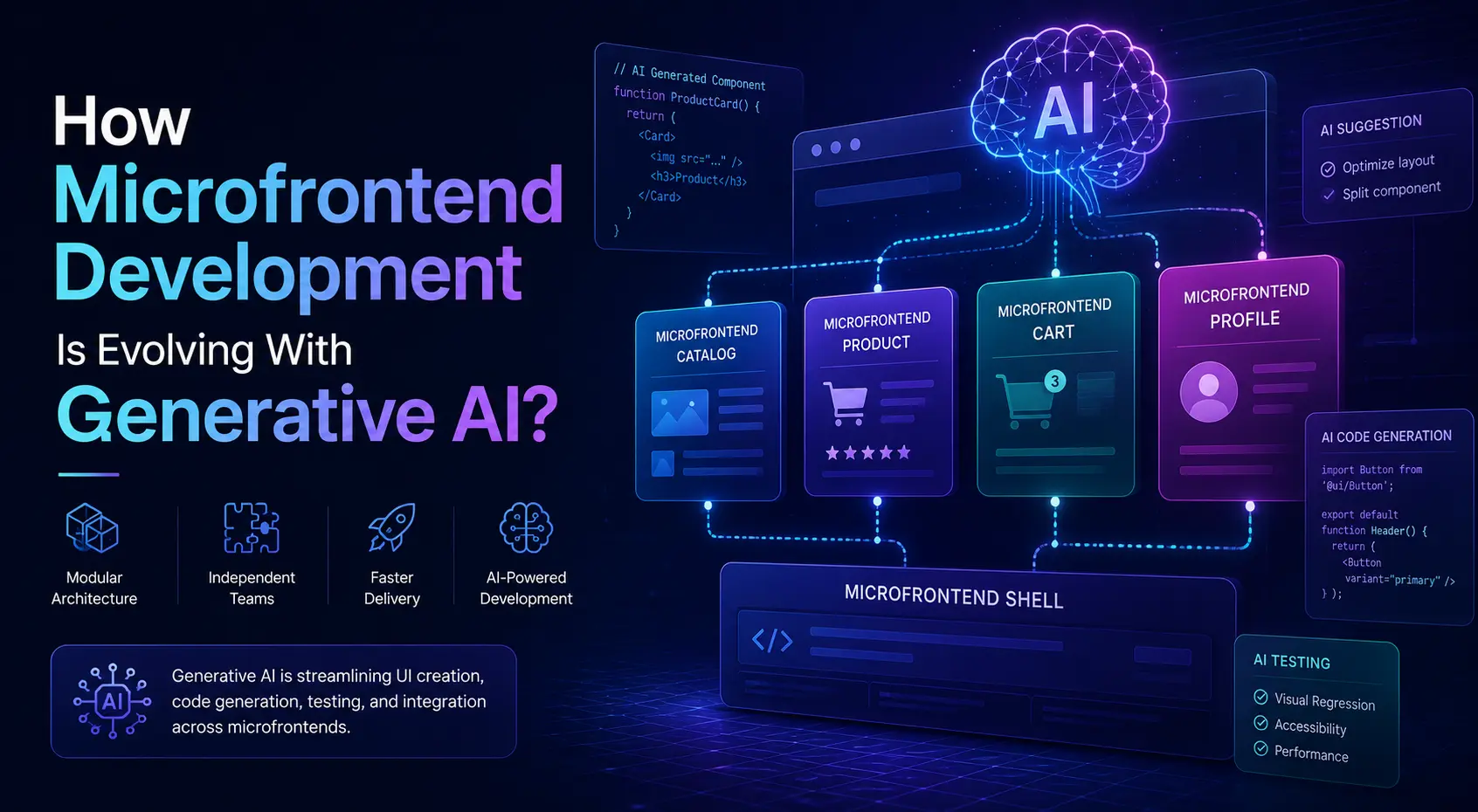
If you’re creating digital products, today it requires more than just developing functional applications. Duplicate components, several frameworks, mismatched buttons, and a deploy pipeline will all start feeling like a burden. In order to solve this concern, microfrontends were built, and now generative AI is changing how teams build, maintain, and scale them. In short: microfrontend development is a way to split a large frontend app into smaller, independently built and deployed pieces, while generative AI is now automating that big chunk of the manual workload that used to slow that process.
Let’s break down what’s changing, why it matters, and what to do about it.
Quick Refresher: What Is Microfrontend Architecture?
This pattern applies the same idea as microservices. However, for the UI layer, it’s a modular web application development used for the frontend instead of the backend. Instead of one giant monolithic front end, here you get several smaller, self-contained apps, often called a “host” (or shell) and multiple “remotes”.
As a result, with the help of this tool, teams can build, test, and ship on their own schedule, eliminating the hassle.
For example, an ecommerce platform has separate microfrontends for product search, customer accounts, payments, and order tracking. Now, different teams can manage these areas independently without waiting for changes from other teams.
In fact, many organizations are adopting this new change as it allows multiple teams to work hand-in-hand while maintaining faster release cycles.
However, microfrontends are born with their own set of challenges. This is because when you manage multiple applications, the most crucial aspects that come into play are coordination, consistent design standards, and proper documentation. Considering, if you lack the right processes, issues like inconsistent user experiences, duplicated work, or increased maintenance will arise.
Where Is Generative AI Truly Making A Difference?

This is where generative AI in frontend development stops being a buzzword and starts doing real work, so let’s get into it.
1. UI Consistency At Scale
One of the classic microfrontend headaches is fragmented design. Here you will notice buttons that look slightly different app to app, and spacing that’s never the same. However, with the emergence of generative AI, you can analyze components across multiple microfrontends, identify inconsistencies, and recommend improvements. This design system automation significantly helps teams maintain a unified design while reducing the time of manual reviews.
2. Smarter Component Reuse
Instead of rebuilding an “Input Field” or “Submit Button” that already exists somewhere else in the organization, AI tools can detect a similar component if it already exists. Further, it also recommends reducing unnecessary duplicate code.
3. Faster Setup And Configuration
The creation of the foundation for microfrontends will involve setting up a number of applications, dependencies, and interactions between various modules.
However, when you integrate AI, you can create the required setup from basic instructions provided to the system. As a result, there will be no time crunch for configuring and building more features.
4. Safer Dependency Updates
Although you make changes to the shared components, it is crucial to ensure the existing applications are working without any glitches. AI is getting better at mapping those dependencies automatically and proposing updates that preserve backward compatibility. These tasks, manually, might have required a very patient human and a lot of coffee.
5. Documentation That Stays Updated
Let’s be honest – nobody loves writing READMEs. AI-generated documentation can help teams maintain clear information about each microfrontend, making it easier for developers to understand, manage, and improve the system over time.
What Are The Challenges Of Combining Generative AI With Microfrontend Approaches?
While Generative AI can make microservices quick and efficient, it does not remove the need for thoughtful planning. Businesses still need to address some crucial challenges to ensure everything developed is working correctly.
Here are notable challenges worth mentioning:
- Maintaining A Consistent User Experience
Many create modules quickly, which initially function effortlessly. In the long run, they do not feel connected. This is because, for an efficient user experience, it is crucial to have design systems, proper shared guidelines, and governance practices.
- Reviewing AI-Generated Code
No matter how efficient AI-generated code is, it requires the scrutiny of a human hand. For this, teams work closely to evaluate security, performance, scalability, and long-term maintainability before the final dispatch.
- Avoiding Unnecessary Complexity
For every kind of project, microfrontend is not necessarily the mandatory approach. So, if it is a smaller project and you try using advanced technologies, it will create more complexity than value.
Therefore, businesses adapting to microfrontend development with generative AI must first evaluate the application size, team structure, and future growth plans.
So, Should Your Team Use AI-Assisted Microfrontends?

Building scalable frontend systems is not solely about chasing after the trendiest architecture. In today’s scenario, the market is highly competitive, and it leans towards matching a pattern to your team’s actual growth curve. If you’re evaluating this for your own stack, here’s a practical way to think it through:
- Multiple teams, multiple frameworks, independent release cycles? Microfrontends, along with AI tooling, can genuinely cut your maintenance overhead.
- Small team, single framework, one release cadence? You probably don’t need microfrontends yet. AI-assisted component libraries built within a single app will get you most of the benefit with less complexity.
- Already running microfrontends but drowning in inconsistency? This is exactly where AI-driven consistency checks and dependency mapping pay off fastest.
The Future Isn’t Just AI Or Microfrontends – It’s Both
Let’s make it clear: with the growth of generative AI, your amil should not be about replacing the judgment calls that make microfrontend development work. Rather, it is removing the tedious parts that used to consume your team’s engineering time. Once implemented strategically, it can make your solid pattern more sustainable for the future. However, when done carelessly, it can automate the wrong architecture within the blink of an eye. So, before introducing anything new in your development plan, think twice. Try to know your team’s actual scaling problem before you reach for either the tooling or the pattern.
FAQS
Microfrontends are a way to split a frontend into smaller parts that can be built and released separately. Generative AI makes this easier by helping teams create starter code, reusable components, and integration patterns faster, so large frontend systems become simpler to grow and maintain.
Generative AI can speed up repetitive tasks like scaffolding components, writing tests, creating documentation, and suggesting code patterns. This lets developers focus more on architecture, user experience, and business logic instead of spending time on routine implementation work.
Yes, it can help a lot. AI tools can suggest test cases, detect likely problem areas, and explain errors in plain language, which makes debugging faster and more efficient across independently developed frontend modules.
The main risks are inconsistent code quality, security issues, duplicated logic, and over-reliance on AI-generated output. Teams still need strong code review, architecture rules, and testing standards to make sure generated code fits the project properly.
Yes, in many cases it lowers the barrier to entry. By automating setup, documentation, and some integration work, AI can help teams adopt microfrontends more confidently, especially when the architecture is large and handled by multiple developers or teams.


2 Comments on “How Microfrontend Development Is Evolving With Generative AI?”
Comments are closed.