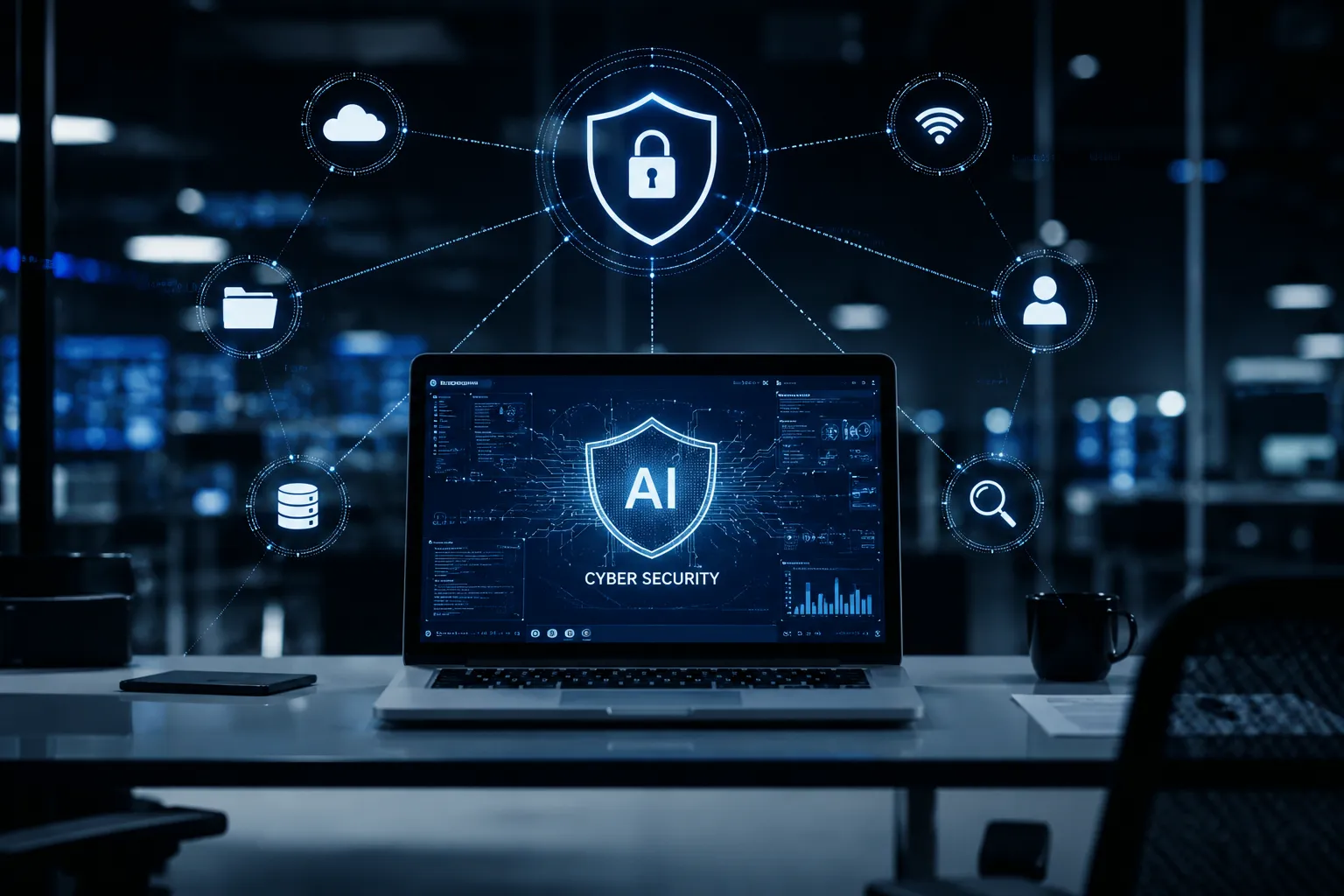
Cybersecurity has become more important than ever. Many people often questioned How AI Is Used in Cybersecurity. Every day, businesses and individuals face new online threats. Hackers use advanced tools to steal personal information, spread malware, and attack computer systems. Traditional security tools are still useful, but they often struggle to keep up with these fast-changing threats.
This is where Artificial Intelligence (AI) makes a big difference. AI helps security systems learn from data, find unusual activities, and respond to attacks much faster than humans. Instead of waiting for a cyberattack to happen, AI can often detect warning signs before serious damage is done.
Today, many companies use AI to protect their networks, websites, cloud systems, and customer data. It works around the clock and can process millions of security events in just a few seconds. This allows security teams to focus on the most important threats instead of checking every alert manually.
What Is AI in Cybersecurity?
Artificial Intelligence in cybersecurity means using smart computer programs to improve digital security. These programs learn from large amounts of data and can recognize patterns that humans may miss. Instead of following only fixed rules, AI keeps learning as it processes new information.
Traditional security software usually works with known rules or virus signatures. It can detect threats that have already been identified. However, modern cyberattacks change very quickly. New malware, phishing emails, and hacking methods appear every day. AI helps solve this problem because it can identify suspicious behavior even if it has never seen that exact attack before.
Machine learning is one of the most common types of AI used in cybersecurity. It studies previous attacks, normal user behavior, and network traffic. Over time, it becomes better at spotting unusual activities. For example, if an employee suddenly logs in from another country at an unusual time, AI can recognize this as suspicious and alert the security team.
AI also helps security systems work faster. Instead of checking thousands of alerts by hand, it can sort them automatically and highlight the most serious risks. This saves time and reduces the workload for cybersecurity professionals.
Another important benefit is continuous monitoring. AI never gets tired or takes breaks. It watches networks and devices all day and night. As soon as it notices something unusual, it can send an alert or even take action to reduce the risk.
Although AI is powerful, it does not replace human experts. Security professionals still make important decisions, investigate complex attacks, and improve security strategies. AI acts as a helpful assistant that makes their work faster, easier, and more accurate.
The New Arms Race in Network Security
Cybersecurity has evolved significantly over the past few years. In the past, most security systems depended on firewalls and antivirus software. These tools were effective against many common threats, but they mainly reacted after an attack had already started.
Today’s cybercriminals use much more advanced methods. They can create automated attacks, send thousands of phishing emails within minutes, and use AI to find weak points in computer systems. Because of this, security teams also need smarter technology to defend their networks.
AI has become one of the strongest tools in this new cybersecurity race. It can examine huge amounts of data much faster than any human. Every second, it checks login attempts, network traffic, user activity, and system behavior. If something looks unusual, it immediately raises an alert.
One major difference between traditional security and AI-powered security is speed. Older systems often wait until a known threat appears. AI looks for unusual behavior instead of waiting for a known attack. This allows it to detect many threats at an earlier stage.
For example, imagine an employee normally signs in from London between 9 a.m. and 5 p.m. One day, the same account suddenly logs in from another country at midnight and starts downloading hundreds of files. AI can quickly recognize that this behavior is different from normal activity. It can warn the security team or temporarily block the account until it is checked.
Modern businesses also face a growing number of automated bot attacks. These bots constantly search websites and networks for weak passwords, software bugs, and security gaps. Since they work all day without stopping, manual monitoring is no longer enough. AI helps organizations detect these automated attacks much faster and reduce the risk before they become serious.
Another advantage is that AI keeps learning. Every new attack gives it more information. As it studies more threats, it becomes better at recognizing similar patterns in the future. This allows organizations to improve their security over time without starting from scratch.
However, AI is not a complete solution on its own. Companies still need strong passwords, regular software updates, employee training, and experienced cybersecurity professionals. When AI works together with these security practices, it creates a much stronger defense against modern cyber threats.
The future of cybersecurity is no longer about simply reacting to attacks. It is about finding risks early, responding quickly, and stopping threats before they cause damage. AI is helping businesses move toward this smarter and more proactive approach to security.
How AI Predicts and Prevents Cyber Threats

One of the biggest advantages of AI is that it can help stop cyber threats before they become serious. Instead of waiting for an attack to happen, AI studies large amounts of security data to find warning signs. This helps organizations take action early and reduce the chance of a successful attack.
Predictive Threat Intelligence
Cyber threats are constantly changing. Hackers create new malware, phishing campaigns, and attack methods every day. It is difficult for humans to track all these changes manually.
AI makes this process much easier. It collects information from different sources such as security reports, threat databases, and network logs. It then looks for patterns that may indicate a new attack.
For example, if AI notices that the same type of malware is spreading across different countries, it can warn organizations before the attack reaches their systems. Security teams can then strengthen their defenses and update their protection tools.
AI also helps identify which systems are most likely to be targeted. If a company has an outdated application or a weak security setting, AI can point it out before hackers find it. This gives businesses time to fix the problem and avoid costly damage.
Large organizations often use AI-powered threat intelligence to stay one step ahead of cybercriminals. Instead of reacting after an attack, they prepare for it in advance.
Automated Vulnerability Scanning
Every software program has the possibility of containing security weaknesses. These weaknesses are called vulnerabilities. If they are not fixed, hackers may use them to gain access to a system.
Checking thousands of files and applications by hand takes a lot of time. AI can scan systems much faster than a human. It checks websites, servers, applications, and networks to find weak points that need attention.
When AI finds a vulnerability, it can rank it based on its level of risk. This helps security teams focus on the most dangerous issues first instead of spending time on minor problems.
Some advanced security systems can even recommend the best solution or automatically install security updates when it is safe to do so. This reduces the time between finding a problem and fixing it.
For example, imagine a company updates its website with new software. AI immediately scans the update and finds a security weakness that could allow hackers to access customer data. The system alerts the IT team, and the issue is fixed before anyone can exploit it.
This faster detection process helps organizations reduce risks and keep their systems protected.
How AI Detects Suspicious Activity in Real Time
Finding unusual behavior is one of the most important jobs in cybersecurity. Hackers often try to act like normal users so they can avoid being detected. AI is very good at spotting small changes that people may not notice.
Instead of looking only for known viruses, AI studies how users, devices, and networks normally behave. If something suddenly changes, it investigates the activity and alerts the security team.
User and Entity Behavior Analytics (UEBA)
Every user has a normal pattern of activity. They usually log in from the same location, use the same devices, and access similar files during working hours.
AI learns these normal habits over time. This creates a baseline for each user and device.
If someone logs in from another country, downloads an unusually large number of files, or tries to access restricted information, AI quickly notices the difference.
For example, an employee normally works from the office in the morning. One night, the same account signs in from another country and starts copying confidential company files. AI immediately recognizes that this behavior is unusual and alerts the security team. In some cases, it can even block the account until the activity is verified.
This helps stop attackers who have stolen usernames and passwords.
AI can also detect suspicious behavior based on typing speed, mouse movements, device information, and login history. Even if hackers know the correct password, their behavior may still look different from the real user.
AI Reduces False Positives
One of the biggest challenges in cybersecurity is dealing with too many security alerts. Conventional security systems frequently produce thousands of alerts each day. Many of these alerts turn out to be harmless.
This leads to a challenge commonly referred to as alert fatigue. When security teams receive too many unnecessary alerts, they may overlook a real attack.
AI helps solve this issue by learning which alerts are important and which ones are normal activities. It studies previous incidents and improves its decisions over time.
For example, if employees regularly work late during a product launch, AI learns that these late-night logins are expected. It avoids creating unnecessary alerts while still watching for suspicious behavior.
This allows security teams to focus on real threats instead of spending hours checking false alarms.
As a result, Security Operations Centers (SOCs) become more efficient. Analysts can investigate serious incidents more quickly, improve response times, and reduce the workload caused by unnecessary notifications.
By combining continuous monitoring with intelligent analysis, AI helps organizations detect threats earlier and respond with greater confidence.
AI Applications in Cybersecurity

AI is used in many areas of cybersecurity. It helps protect networks, devices, emails, cloud systems, and sensitive data. Instead of depending only on traditional security methods, organizations now use AI to detect threats faster and respond more effectively.
Below are some of the most common ways AI is used in cybersecurity.
AI-Powered Endpoint Security
An endpoint is any device connected to a network, such as a laptop, desktop computer, smartphone, tablet, or server. These devices are common targets for cybercriminals because they often store valuable data.
AI continuously monitors these endpoints for suspicious activity. It checks running programs, login attempts, file changes, and system behavior. If it notices unusual actions, it immediately alerts the security team.
For instance, if malware suddenly begins encrypting files on an employee’s laptop, AI can identify this unusual behavior within seconds. It can isolate the infected device from the network to stop the malware from spreading to other computers.
This quick response helps reduce damage and protects important business information.
AI in Cloud Security
Many businesses now store their data and applications in the cloud. While cloud services offer flexibility and convenience, they also create new security challenges.
AI continuously monitors cloud environments 24/7 to identify potential security threats. It looks for unusual login attempts, unauthorized access, and unexpected changes to cloud resources.
For example, if someone tries to access cloud storage from an unknown device in another country, AI can identify the unusual activity and notify administrators immediately.
AI also helps detect configuration mistakes that may leave cloud systems exposed to attackers. Finding these issues early helps organizations protect sensitive customer and business data.
AI for Email Security
Email remains one of the most common ways hackers attack businesses. Phishing emails often look like genuine messages and trick users into sharing passwords or downloading harmful files.
AI examines emails before they reach the user’s inbox. It checks the sender’s reputation, writing style, links, attachments, and other hidden details.
If an email appears suspicious, AI can move it to the spam folder or block it completely.
For example, if an attacker sends an email pretending to be a company’s CEO and asks an employee to transfer money, AI can detect unusual language patterns or fake sender information and warn the recipient before any damage occurs.
This extra layer of protection reduces the risk of phishing attacks.
AI for Network Monitoring
Business networks generate huge amounts of traffic every second. It is impossible for humans to monitor every connection manually.
AI continuously watches network activity and learns what normal traffic looks like. If it detects unusual data transfers, repeated login failures, or unexpected communication between devices, it quickly raises an alert.
For example, if a computer suddenly begins sending large amounts of confidential data to an unknown server, AI can identify the suspicious behavior and stop the connection before sensitive information is stolen.
Continuous monitoring helps organizations respond to threats much faster than traditional methods.
AI for Malware Detection
Traditional antivirus software mainly detects malware that is already known. Modern hackers often create new versions of malware that can avoid signature-based detection.
AI solves this problem by studying how programs behave instead of only checking their signatures.
For example, if a file starts changing system settings, encrypting documents, or attempting to spread across a network, AI recognizes these actions as suspicious, even if the malware has never been seen before.
This allows organizations to detect new and unknown threats more effectively.
As cyberattacks continue to evolve, AI-powered malware detection provides stronger protection against both existing and emerging threats.
Fighting AI With Better AI

Hackers are also using artificial intelligence to improve their attacks. They can create more convincing phishing emails, fake voices, realistic videos, and automated hacking tools.
To defend against these advanced threats, security experts are using even smarter AI systems.
Defeating Deepfakes and Social Engineering
Deepfake technology allows criminals to create fake videos and voice recordings that closely resemble real people. These fake messages can be used to trick employees into sharing confidential information or approving financial transactions.
AI helps identify these fake images, videos, and audio recordings by analyzing details that humans may not notice. It can detect unusual voice patterns, facial movements, and editing artifacts that reveal a deepfake.
AI also improves protection against phishing attacks. It examines email content, writing style, sender information, and suspicious links to determine whether a message is genuine.
Even with these tools, employee awareness remains important. Organizations should regularly train staff to verify unusual requests, avoid clicking unknown links, and confirm sensitive instructions through trusted communication channels.
Neutralizing Adversarial Machine Learning
Some attackers try to fool AI systems instead of attacking computers directly. This technique is known as adversarial machine learning.
Hackers may slightly modify malware or manipulate data so that AI incorrectly classifies it as safe.
To defend against this, cybersecurity experts train AI models using different attack scenarios. This makes the models stronger and more resistant to manipulation.
For example, security researchers may expose AI systems to thousands of modified malware samples during training. Over time, the AI learns to recognize these tricks and continues detecting malicious files accurately.
This process is similar to strengthening the human immune system. The more threats the AI learns from, the better it becomes at recognizing future attacks.
Although attackers continue developing new methods, improved AI models help organizations stay prepared for increasingly sophisticated cyber threats.
Automating Incident Response
Finding a cyberattack is only the first step. The next challenge is responding to it as quickly as possible. Every minute matters because attackers can steal data, spread malware, or damage important systems in a very short time.
AI helps organizations respond faster by automating many security tasks. Instead of waiting for someone to review every alert, AI can take immediate action based on predefined security rules. This speeds up the response process and reduces the overall impact of the attack.
Instant Incident Containment
When AI detects a serious threat, it can act within seconds. This is much faster than waiting for a human to investigate the issue.
For example, if ransomware is detected on an employee’s computer, AI can immediately disconnect that device from the company network. This prevents the malware from spreading to other systems.
AI can also block suspicious IP addresses, disable compromised user accounts, stop harmful processes, and close vulnerable network ports while the investigation continues.
This rapid response helps protect sensitive data and reduces business downtime.
Smart Playbook Automation
Many security incidents require the same set of actions every time. Instead of performing these tasks manually, AI can follow pre-approved response plans known as security playbooks.
For example, after detecting a phishing attack, AI can automatically:
- Block the malicious email.
- Delete the same email from all other inboxes.
- Alert affected users.
- Create a security ticket.
- Collect evidence for investigation.
- Generate an incident report.
This automation saves valuable time and allows cybersecurity teams to focus on more complex investigations instead of repetitive tasks.
Balancing Automation With Human Oversight
Although AI is very powerful, it should not make every decision on its own.
Some cyberattacks are complex and require human judgment. AI may detect suspicious activity, but experienced security professionals are still needed to understand the full situation and decide the best response.
This approach is often called Human-in-the-Loop security. AI handles routine tasks and provides useful recommendations, while human experts review important decisions and investigate unusual cases.
For example, AI may recommend blocking a user account after detecting suspicious behavior. Before taking permanent action, a security analyst can confirm whether the activity is actually malicious or simply the result of business travel or another legitimate reason.
Combining AI with human expertise creates a stronger and more reliable security system.
Benefits of AI in Cybersecurity
AI offers many advantages for organizations of all sizes. It improves security while reducing the workload for IT teams.
Some of the biggest benefits include:
- Faster threat detection: AI can analyze huge amounts of security data within seconds and detect threats much earlier than manual monitoring.
- 24/7 monitoring: AI works continuously without breaks. It protects systems day and night, even when security teams are offline.
- Quicker incident response: Automated actions help contain attacks before they spread across the network.
- Better accuracy: AI learns from previous attacks and improves its ability to identify real threats over time.
- Reduced false alerts: Machine learning filters unnecessary warnings, allowing security teams to focus on serious incidents.
- Improved productivity: AI automates repetitive security tasks, giving cybersecurity professionals more time for advanced investigations.
- Stronger protection against new threats: AI can identify unusual behavior even when dealing with previously unknown malware or attack methods.
These benefits have made AI one of the most important technologies in today’s cybersecurity landscape.
Challenges of AI in Cybersecurity
Despite its many benefits, AI is not perfect. Organizations should understand its limitations before depending on it completely.
One challenge is the cost of implementation. Advanced AI security platforms can be expensive, especially for small businesses.
AI also depends on high-quality data. If it learns from incorrect or incomplete information, its decisions may become less accurate.
Another concern is that hackers are also using AI. They can develop smarter phishing attacks, create realistic deepfakes, and design malware that changes its behavior to avoid detection.
Privacy is another important issue. AI often analyzes large amounts of user and network data. Organizations must handle this information responsibly and follow privacy regulations.
Finally, AI should never replace human expertise. Skilled cybersecurity professionals are still essential for investigating complex attacks, strengthening security policies, and making critical decisions.
Best AI Cybersecurity Tools
Many well-known cybersecurity companies now include AI in their security platforms. These tools help organizations detect threats, monitor networks, and automate incident response.
Some popular AI-powered cybersecurity solutions include:
- Microsoft Defender
- CrowdStrike Falcon
- SentinelOne
- Darktrace
- Palo Alto Networks Cortex
- IBM QRadar
- Google Security Operations
- Cisco SecureX
Each platform offers different features, but they all use AI to improve threat detection and reduce response times.
Future of AI in Cybersecurity
AI will continue to play a bigger role in cybersecurity over the coming years. As cyber threats become more advanced, security systems must also become smarter.
Future AI systems are expected to detect attacks even earlier, automate more security tasks, and provide better recommendations for security teams.
Generative AI is also becoming part of cybersecurity. It can help analysts investigate incidents, summarize security reports, and answer technical questions more quickly.
At the same time, organizations will continue investing in human expertise. The strongest security strategy will combine intelligent AI systems with skilled cybersecurity professionals.
Conclusion
Artificial intelligence has changed the way organizations protect their digital systems. It helps detect threats faster, monitor networks around the clock, reduce false alerts, and automate many security tasks that once required hours of manual work.
However, AI cannot fully replace human expertise. The best cybersecurity strategy combines intelligent technology with skilled professionals, regular software updates, strong passwords, and employee awareness.
As cyber threats continue to evolve, businesses that use AI responsibly will be better prepared to defend their data, protect their customers, and respond quickly to new security challenges. AI is no longer just an emerging technology—it has become an essential part of modern cybersecurity.
FAQS
AI in cybersecurity refers to the use of artificial intelligence to detect, analyze, prevent, and respond to cyber threats automatically. It helps organizations identify suspicious activities much faster than traditional security tools.
AI plays an important role in modern cybersecurity by detecting threats, monitoring networks, identifying unusual activity, and responding to attacks quickly. It helps organizations improve security and reduce the impact of cyber threats.
AI helps in cybersecurity by analyzing large amounts of data, detecting suspicious behavior, preventing cyberattacks, reducing false alerts, and automating security tasks. This allows security teams to respond to threats faster and more accurately.
No. AI supports cybersecurity professionals by automating routine tasks and analyzing large amounts of data. Human experts are still needed to investigate complex threats and make important security decisions.
Instead of relying only on known virus signatures, AI studies how files and programs behave. If a program performs suspicious actions, AI can identify it as potential malware even if it is completely new.


One Comment on “How AI Is Used in Cybersecurity”
Comments are closed.