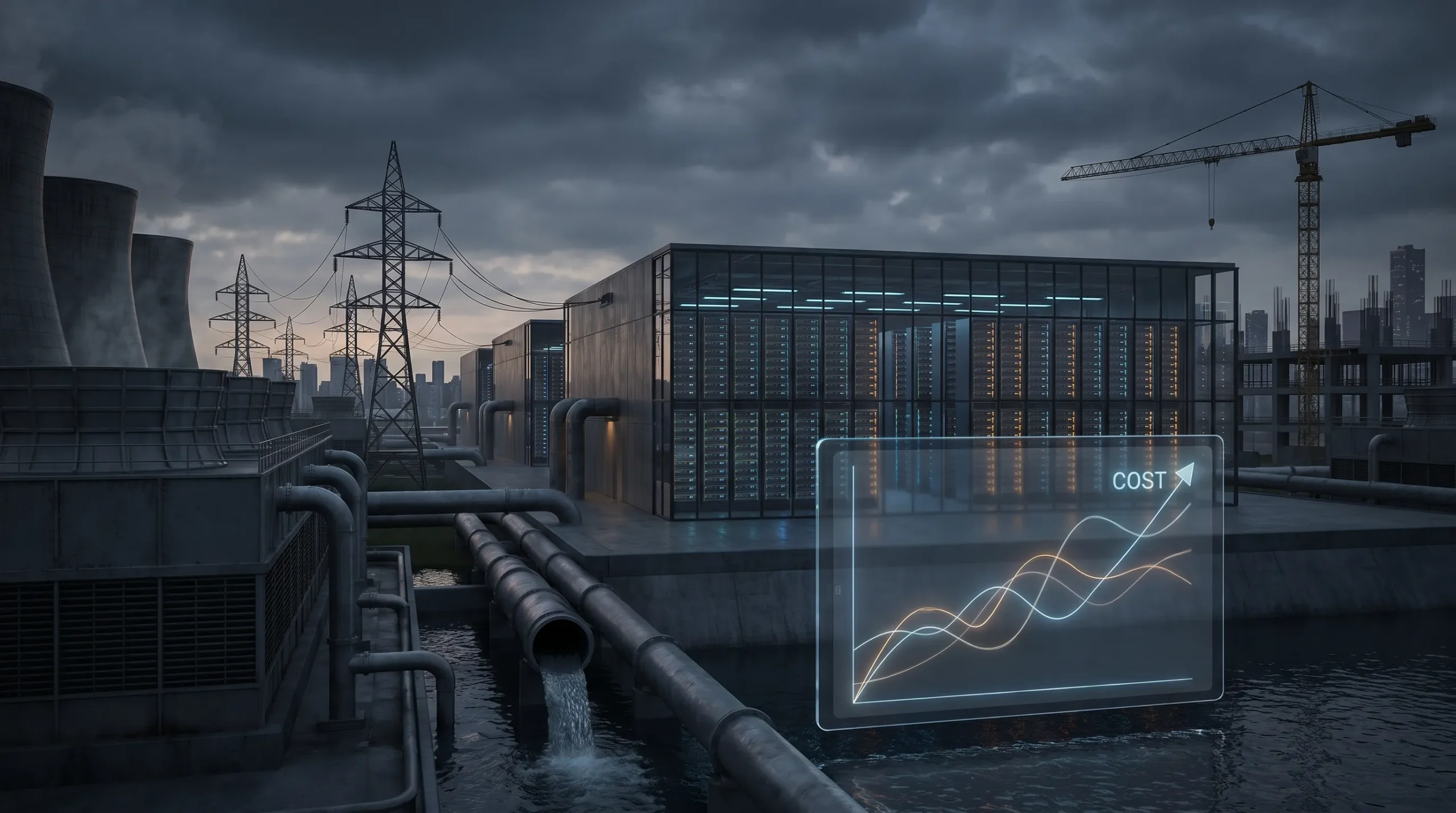
A chatbot reply feels weightless, but the machines behind it are not. Every model training run, AI response, image request, and automated workflow depends on data centers filled with power-hungry servers, cooling equipment, batteries, and network gear. That physical system is the reason the cons of AI data centers deserve close attention.
The drawbacks go beyond electricity use. AI data centers can consume water, produce carbon emissions, pressure local grids, create electronic waste, occupy large areas of land, generate noise, raise public costs, and deepen inequality between communities that host them and companies that profit from them.
AI data centers can support useful innovation, but their value must be weighed against measurable environmental, economic, and social costs.
AI Data Centers Are Driving Electricity Demand to New Highs

AI workloads need more power than basic web hosting, file storage, and many business apps. Large models require high-performance computing during training, then continue drawing power during inference as millions of users submit requests.
The IEA’s Energy and AI analysis estimates that data centers used about 415 terawatt-hours (TWh) of electricity worldwide in 2024. That figure could reach about 945 TWh by 2030.
Training and Inference Need Constant Computing
Graphics processing units, or GPUs, perform many calculations at once. That makes them useful for AI, but large GPU clusters can draw several kilowatts per server while running. Training is intense and often lasts days or weeks. Inference continues after launch and may become the larger burden when a model serves users at scale.
A generative AI request usually requires more computing than a basic webpage, database lookup, or standard search query. Even when each request seems small, billions of requests create a large ongoing load.
Cooling and Backup Systems Add More Power Use
AI servers create dense heat, so facilities need air cooling, liquid cooling, chilled water, pumps, fans, and heat exchangers. Batteries, power distribution gear, uninterruptible power supplies, and backup generators add to the load.
Power usage effectiveness, or PUE, compares total facility power with the power used by IT equipment. A lower PUE shows better efficiency, but efficiency gains may not reduce total use when AI demand grows faster. Ireland’s Central Statistics Office found that data centers consumed 21% of metered electricity in 2023, showing how a concentrated industry can become a regional grid issue.
Grid Expansion Can Raise Costs and Reliability Risks
Large facilities may require new substations, transmission lines, gas plants, or renewable-energy contracts. Grid congestion can delay other projects, while utilities may recover upgrade costs through broader customer rates.
A fair review should examine the facility’s peak demand, location, new generation needs, and who pays for grid work. It should also ask whether a project can reduce its load during stressed periods.
Also Read: AI Search Optimization Platforms With Best Data History
Water Consumption Makes AI Infrastructure a Local Environmental Issue

AI data centers may draw water directly for cooling and indirectly through electricity generation. The impact depends on climate, cooling design, seasonal demand, and whether the facility uses drinking water, recycled water, or reclaimed supplies.
Evaporative Cooling Can Consume Large Volumes
Cooling towers remove heat by turning water into vapor. Water withdrawal means water taken from a source, while water consumption means water not returned right away, often because it evaporates.
The Berkeley Lab report estimates that U.S. data centers directly consumed about 17 billion gallons of water in 2023. Depending on growth and cooling choices, annual use could reach roughly 16 to 33 billion gallons by 2028.
Data Centers Can Compete With Communities
A global water share can look small while a local impact becomes severe. A facility near a drought-prone city, farm region, or strained water system may compete with homes, agriculture, and wildlife during the hottest months.
In January 2026, OPB reporting said Google’s three data centers used about one-third of The Dalles, Oregon’s water in 2024. City leaders disputed that reservoir expansion was for Google, while the city’s water plan identified an unnamed industrial user requiring about one million gallons daily. Such cases show why facility-level and seasonal water data matter.
Water-Efficient Cooling Creates Trade-Offs
Direct-to-chip liquid cooling, closed-loop systems, dry coolers, and reclaimed water can cut on-site demand. Yet air cooling may use more electricity, while liquid systems can cost more to build and maintain.
“Waterless” cooling does not erase the full water footprint. Power plants and semiconductor factories also consume water, so a complete assessment must include the water used across the facility’s supply chain.
AI Data Centers Increase Emissions and Energy Infrastructure Dependence

Data centers produce emissions through backup generators and indirectly through the power grid. A renewable-energy contract may cover annual use without matching the facility’s demand hour by hour.
Fossil Fuels Can Fill Power Gaps
When wind or solar output falls, utilities may turn to natural gas, coal, or diesel. New clean-energy projects can also take years to build, while data centers may need power sooner.
The IEA projects emissions from electricity used by data centers could rise from about 180 million metric tons today to 300 million metric tons in 2035 in its base case. That is a global estimate, not the footprint of every facility, but it shows why annual renewable matching differs from 24/7 carbon-free energy.
Backup Generators Create Local Pollution
Diesel generators and gas turbines provide power during outages and grid constraints. They can emit nitrogen oxides, fine particles, sulfur oxides, and carbon dioxide, especially if testing becomes more frequent.
Local reviews should examine air permits, fuel type, emissions controls, operating-hour limits, and independent monitoring. These questions matter most when generators sit near homes, schools, or already polluted industrial areas.
Carbon Claims May Hide the Full Footprint
An AI data center’s carbon footprint includes operational emissions, purchased electricity, construction materials, servers, chips, batteries, and transmission equipment. Concrete and steel can create large emissions before the first model runs.
A credible disclosure should separate location-based emissions from market-based claims. It should also report hourly clean-energy matching, construction emissions, supply-chain impacts, and the limits of offsets.
AI Hardware Creates E-Waste and Supply-Chain Pressure
The physical footprint of AI includes GPUs, memory, storage, networking equipment, batteries, cooling systems, and power gear. Hardware may become outdated while the building remains useful.
Fast Chip Upgrades Shorten Hardware Lifecycles
New models often need faster GPUs and larger memory pools. Operators may replace hardware before the end of its technical life, creating e-waste and difficult data-destruction work.
The UN Global E-waste Monitor reported 62 million tonnes of electronic waste in 2022, with only 22.3% formally collected and recycled. Better procurement should favor repair, modular upgrades, resale, refurbishment, verified recycling, and public end-of-life reporting.
Chip Manufacturing Uses Major Resources
The footprint starts in semiconductor factories, which require large amounts of energy, ultrapure water, specialty chemicals, clean-room space, metals, and transport. Mining and refining add further impacts.
Supply chains also create risk. The IEA says China accounts for about 99% of refined gallium supply, and data-center demand for gallium could exceed 10% of today’s supply by 2030. Dependence on a few chip, packaging, and networking suppliers can raise prices and delay projects.
AI Data Centers Can Raise Community Costs and Inequality
Large campuses need land for buildings, substations, transmission corridors, cooling systems, generators, parking, and expansion. Construction can disturb habitat, increase runoff, and convert farmland or open space.
Noise from fans and cooling equipment may continue around the clock. Construction traffic, freight deliveries, generator tests, and higher industrial activity can affect sleep, health, and property values. Local planning records and noise studies should guide decisions instead of broad job promises.
Tax breaks and discounted utility rates can shift costs to the public. Communities should examine expected jobs, water limits, clawbacks, local hiring rules, emissions standards, emergency services, and responsibility for grid upgrades. In The Dalles, OPB reported that Google received a 92% property-tax discount, while planned water-system work could help push residential water bills up by 99% by 2036.
AI Data Centers Face Reliability and Financial Risks
Concentrated computing creates single points of failure. A power outage, cooling breakdown, fire, flood, fiber cut, cyberattack, or equipment shortage can disrupt AI models, cloud services, business systems, and public workloads at once.
Companies should assess recovery-time goals, backup power duration, geographic diversity, offline options, and dependence on one cloud provider. A facility that looks efficient on paper may still be fragile if it lacks regional backups.
AI data center costs also remain high. Land, construction, GPUs, networking, electricity, cooling, staffing, security, and hardware replacement require major investment. Projects can become stranded assets if demand forecasts fail, regulations tighten, model designs change, or more efficient chips reduce the need for older capacity.
Limited access to GPUs, electricity, water, and skilled engineers can also hurt smaller firms, schools, and public-interest groups. Shared research systems, efficient models, flexible workload scheduling, and clear pricing can reduce that concentration.
Conclusion
The main cons of AI data centers are physical and local. They include electricity demand, water consumption, emissions, electronic waste, mining pressure, land use, noise, public costs, supply-chain exposure, and reliability risks.
The footprint varies by location, cooling system, workload, power mix, and governance. A facility using reclaimed water and new carbon-free power may have a different impact from one using potable water and fossil-fuel generation.
Before approving or funding a project, ask how much electricity and water it will consume, who will pay for new infrastructure, what emissions and waste it will disclose, and how nearby residents will be protected. The central issue is whether AI data centers can reduce their costs and distribute them fairly while still delivering useful services.
FAQS
They can be. AI data centers use substantial electricity, require water for cooling in many designs, and create indirect emissions when their power comes from fossil fuels; manufacturing and eventually replacing servers also adds to their environmental footprint. Their impact varies greatly by location, cooling system, hardware efficiency, and the source of electricity.
They are neither entirely good nor entirely bad. They provide computing capacity for services such as cloud applications, cybersecurity, scientific research, communication, and AI-enabled tools, but they can also strain grids, consume water, create noise, and affect nearby communities.
Living near a data center is not automatically unhealthy, but potential risks deserve local evaluation. Concerns can include constant equipment noise, diesel-generator emissions during testing or outages, construction dust and traffic, water stress, and pollution from the power plants serving the facility.
Five major disadvantages or risks of AI are:
Bias and discrimination: Biased data or design can produce unfair outcomes in areas such as hiring, loans, policing, or healthcare.
Privacy loss: AI systems can collect, infer, and process large amounts of personal information.
Misinformation and fraud: Generative tools can produce convincing false text, images, voices, and videos at scale.
Job disruption: AI can automate tasks and reshape roles faster than some workers can retrain.
Opaque decisions and accountability gaps: It can be difficult to understand, audit, or challenge a high-stakes automated decision.
No occupation is guaranteed to be untouched, because AI can automate parts of nearly any job. Roles that are comparatively harder to replace combine physical work in unpredictable settings, hands-on care, real-world responsibility, and human trust.


One Comment on “What Are the Cons of AI Data Centers?”
Comments are closed.