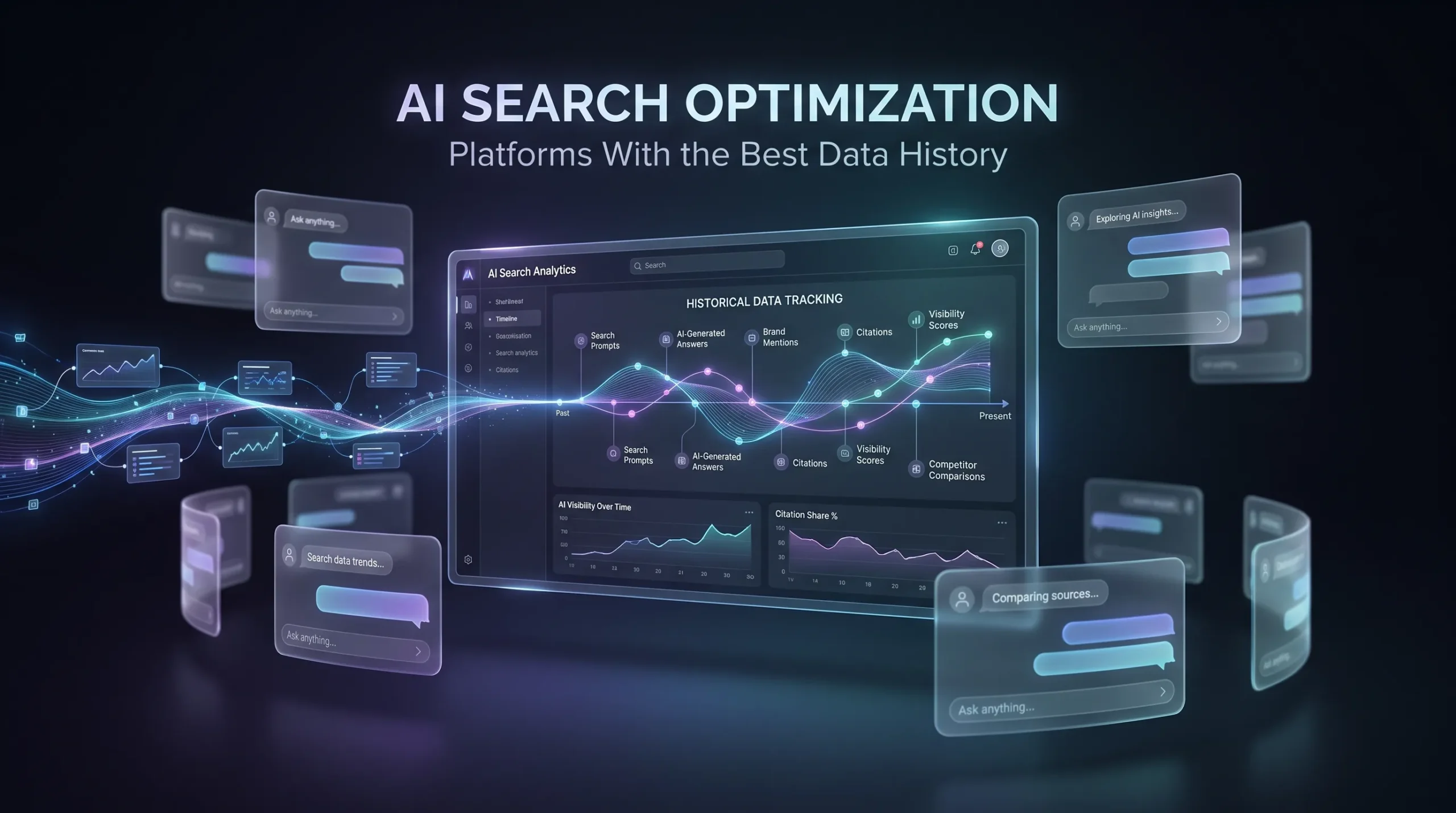
Traditional rank tracking misses a growing part of how people find brands. Customers now ask ChatGPT, Google AI Overviews, Perplexity, Gemini, and other answer engines for recommendations, explanations, and comparisons. When comparing AI search optimization platforms with best data history, a current visibility score isn’t enough. You need records that show whether your prompts, citations, and sources improved after a content update or campaign. Profound, Semrush, Ahrefs, Otterly.AI, Peec AI, Scrunch AI, and BrightEdge each take a different approach to coverage, reporting depth, and cost.
What Historical Data Should an AI Search Optimization Platform Track?
A useful platform preserves more than a daily brand mention total. It should let you revisit past answers, see which competitors appeared, and identify the sources that answer engines selected at that time.
Visibility trends show movement over time
Historical visibility trends measure how often your brand appears for a defined prompt set across selected engines. A daily record is more useful than a monthly snapshot because AI answers can shift quickly after a model, index, or cited source changes.
Look for charts that retain individual prompt results, not only a blended score. That detail helps you separate a genuine improvement from a sudden change in one high-volume prompt. Semrush’s guide to optimizing for AI search also makes the broader point: visibility requires tracking how brands surface in generative results, not only organic rankings.
Citations and sources explain the score
Citation tracking records whether an answer engine linked to or named your pages. Source tracking goes further by preserving the URLs and domains used to build an answer, even when your own site isn’t cited.
The strongest records answer practical questions: Which page disappeared? Did a competitor gain citations after publishing a guide? Did Google AI Overviews and ChatGPT rely on the same domains?
A visibility increase without preserved prompt responses and cited sources is hard to diagnose and even harder to repeat.
Before you buy, check daily versus weekly refreshes, export options, API access, supported locations, and retention limits. Historical coverage can differ by plan, engine, prompt volume, domain, and country.
AI Search Optimization Platforms With Best Data History Compared
Feature names, prompt allowances, and retention policies change often. Confirm current September 2026 plan details before signing, especially if a long historical record is a contract requirement.

Enterprise depth versus existing SEO ecosystems
Profound is a strong enterprise candidate when your team needs broad answer-engine monitoring and substantial prompt coverage. Its public starter plan begins at $99 per month, tracks ChatGPT, and includes 50 prompts. Higher plans add more engines and daily tracking, while enterprise pricing is custom. Ask sales to document the exact retention period for responses, citations, and source history.
Semrush fits teams already using its SEO suite. Its AI Visibility Toolkit is publicly listed at $99 per month per domain when billed annually, with 25 custom prompts. Higher SEO and AI Search plans list daily tracking tiers with 50, 100, or 200 prompts. Its familiar reporting environment can reduce friction for established Semrush users.
Ahrefs Brand Radar takes a usage-based route. Public pricing lists single-platform access at $199 per month per index, while all-platform access is listed at $699 per month with 2,500 custom prompt checks. Additional check packs can expand volume. Ahrefs is especially useful when you want AI visibility work near backlink and competitor research.
| Platform | Public pricing signal in September 2026 | Best-fit consideration |
|---|---|---|
| Profound | Starts at $99 per month | Broad enterprise intelligence |
| Semrush | $99 per domain monthly, billed annually | Existing Semrush workflows |
| Ahrefs | $199 per index, $699 all platforms | Usage-based prompt checks |
| Otterly.AI | Check current plan details | Affordable testing |
| Peec AI | Check current plan details | Multilingual monitoring |
| Scrunch AI | Check current plan details | Persona and workflow features |
| BrightEdge | Request current quote | Enterprise evaluation |
Smaller teams need clear limits
Otterly.AI is worth a look for teams testing AI visibility tracking on a leaner budget. Peec AI belongs on multilingual shortlists, while Scrunch AI may suit teams that organize research around audience personas and content workflows.
BrightEdge should be evaluated alongside other enterprise platforms if you need a larger vendor relationship. However, don’t assume any platform retains the same depth of historical data at every price tier. Request a sample export with older prompt results before committing.
For wider context on the category, this AI visibility overview explains why citations and answer-engine mentions have become useful brand metrics.
How to Choose the Right AI Visibility Platform for Your Team
Start with scale. Count the brands, domains, countries, languages, prompts, competitors, and AI engines you need to monitor. A low entry price can become expensive when each prompt, engine, or location consumes a separate allowance.
Run a controlled pilot first
Use the same fixed prompt set in every trial for at least several weeks. Include branded questions, category questions, comparison prompts, and problem-based queries. Then compare refresh frequency, historical answer access, citation detail, competitor views, exports, API access, seats, integrations, and support quality.
A practical fit guide is simple:
- Choose Profound when broad intelligence and enterprise-scale reporting matter most.
- Pick Semrush or Ahrefs when your SEO team already works in those ecosystems.
- Test Otterly.AI when cost is the first constraint.
- Consider Peec AI for multilingual needs and Scrunch AI for persona-led workflows.
No platform proves revenue impact on its own. Pair visibility records with web analytics, conversions, assisted leads, content publication dates, and campaign activity. A detailed AI search citations framework can also help connect mentions to pages and lead opportunities.
Choose Data You Can Explain Later
The best AI search optimization platforms with best data history preserve reliable prompt, citation, and source records at the scale your team actually needs. Profound is a strong enterprise option, while Semrush, Ahrefs, Otterly.AI, Peec AI, and Scrunch AI offer different balances of price, ecosystem fit, coverage, and workflow tools.
Verify September 2026 pricing and retention terms in writing. Then run a controlled trial and judge the platform by whether its history helps explain real business outcomes.
FAQS
There is no universal winner. Perplexity is a strong choice for source-backed research and inline citations, ChatGPT Search is useful when you want search combined with writing or analysis, and Google AI Mode or Gemini is convenient for people who rely heavily on Google services. Choose according to your priority: citations, general productivity, or Google integration.
No. SEO is changing rather than disappearing. Search engines still rely on discoverability, useful content, technical accessibility, credibility, and relevance; AI-generated answers simply add another way for people to find information. The strongest strategy is to create original, genuinely helpful content while continuing to optimize for traditional search and AI-powered results.
You cannot directly control whether an AI system cites your page, but you can improve its chances of being discovered and trusted. Keep important pages crawlable and indexable, answer specific questions clearly, demonstrate first-hand expertise, support claims with reliable information, use descriptive headings, and maintain accurate business details. Measure both conventional rankings and mentions or citations in AI search platforms.
The best tool depends on the job. Semrush is a strong all-in-one option for keyword research, site audits, competitor analysis, rank tracking, and AI-visibility monitoring; Surfer is useful for on-page content guidance; Frase can suit writers who want research and content optimization in one workflow; and specialized platforms such as Otterly.ai or Profound focus more heavily on tracking brand visibility in AI answers. Use AI to support research and analysis, but verify recommendations before publishing.
Yes. ChatGPT can help with keyword clustering, search-intent analysis, title and meta-description ideas, content briefs, schema drafts, internal-link suggestions, technical-SEO checklists, and rewriting for clarity. It should not replace tools that access live crawl, ranking, backlink, or analytics data, and its recommendations should be checked against your website and current search guidelines.


