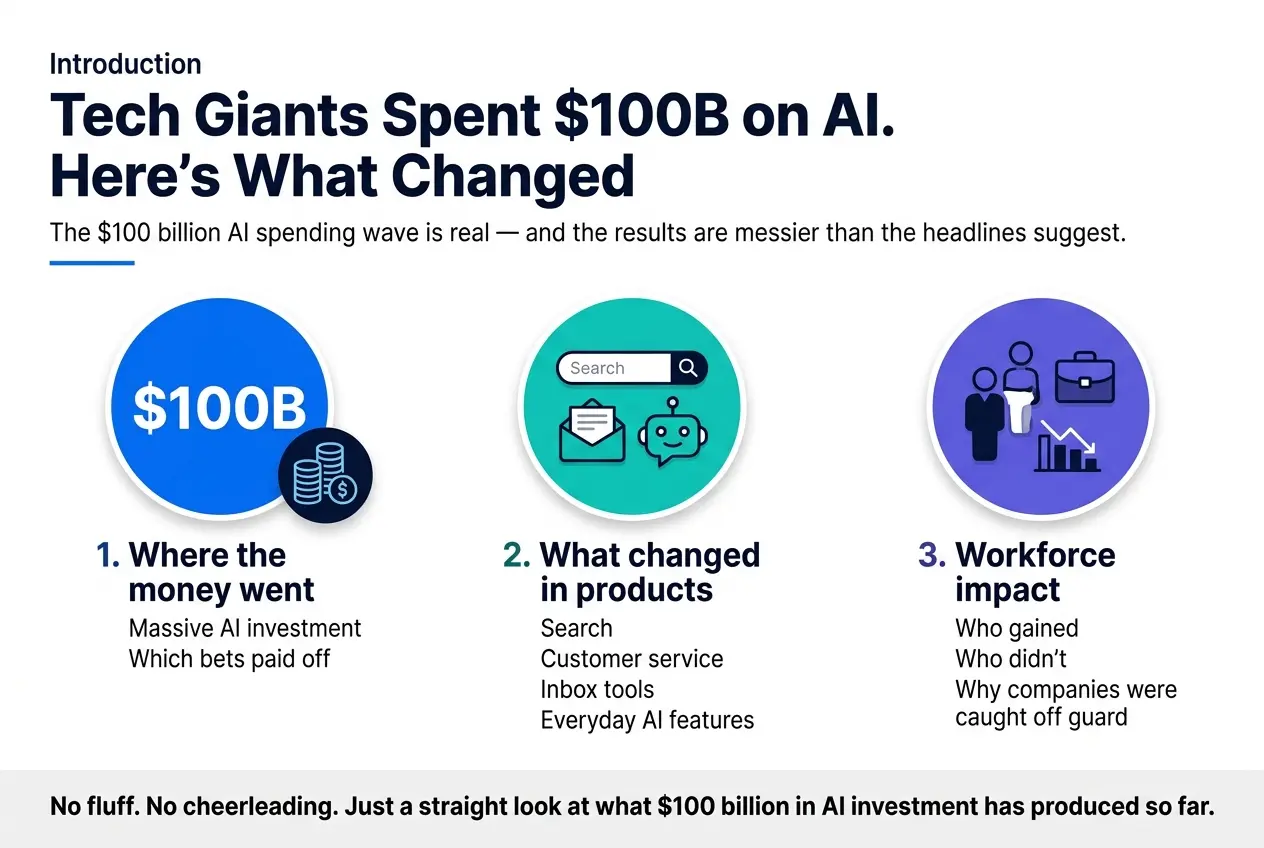
The $100 billion AI spending wave is real, and the results are messier — and more interesting — than the headlines suggest.
This breakdown is for anyone trying to cut through the hype: business owners, tech professionals, and curious people who want to know what all that money actually bought. If you’ve watched companies like Google, Microsoft, and Amazon pour billions into AI and wondered whether it moved the needle, you’re in the right place.
Here’s what we’ll cover:
- Where the money went — the scale of AI investment and which bets paid off
- What actually changed in products you use every day — from search to customer service to your inbox
- The workforce impact — who gained, who didn’t, and why it caught a lot of companies off guard
No fluff, no cheerleading. Just a straight look at what $100 billion in AI investment has produced so far.
Which Companies Spent the Most and Why

A handful of companies drove the overwhelming majority of AI spending, and their motivations weren’t identical even if their checkbooks looked similar.
Microsoft topped the charts by committing over $13 billion to OpenAI alone, on top of billions more in internal Azure AI infrastructure. The reason was survival — Microsoft had watched Google dominate search for two decades and saw generative AI as its best shot at reshuffling the deck. Embedding ChatGPT into Bing, Office 365, and GitHub Copilot wasn’t just a product strategy. It was an existential bet.
Google and Alphabet responded with spending that reached into the tens of billions across DeepMind, Google Brain (now merged into Google DeepMind), and the development of Gemini. Google had arguably invented much of the foundational AI research (the Transformer architecture came from their labs), so heavy spending was partly about defending territory they felt they’d built.
Amazon poured capital into AWS AI services and dropped $4 billion into Anthropic, the startup behind the Claude model family. Amazon’s angle was infrastructure dominance — the company understood that whoever powers AI workloads in the cloud controls a significant slice of the future economy.
Meta took a different path by going all-in on open-source AI through its LLaMA model series while still spending billions on GPU clusters and AI research. Mark Zuckerberg’s public stance was that open-source AI would be better for the world and better for Meta’s long-term competitive position. Critics called it a calculated move to commoditize AI models and undercut competitors.
Apple, though quieter publicly, invested heavily in on-device AI capabilities and acquired dozens of AI startups, reportedly spending more on acquisitions than any other company in some years.
Here’s a rough comparison of estimated AI-related spending commitments among the major players:
| Company | Estimated AI Spend (2020–2024) | Primary Focus |
|---|---|---|
| Microsoft | $30B+ | OpenAI partnership, Azure AI, Copilot integration |
| Google/Alphabet | $25B+ | Gemini models, DeepMind, TPU infrastructure |
| Amazon/AWS | $20B+ | Cloud AI services, Anthropic investment |
| Meta | $18B+ | LLaMA open-source models, AI infrastructure |
| Apple | $10B+ | On-device AI, acquisitions |
How Investment Grew Year Over Year
The growth trajectory of AI spending wasn’t gradual — it was almost vertical starting around late 2022.
Before the release of ChatGPT in November 2022, AI investment was already climbing, but it looked like a controlled ascent. Venture funding in AI startups hovered around $20–30 billion annually in 2020 and 2021. Corporate R&D spending on AI was significant but largely buried inside broader technology budgets.
Then ChatGPT happened. Within weeks of its release, the entire industry recalibrated. Microsoft accelerated its OpenAI deal. Google declared an internal “code red.” Every major tech company fast-tracked AI roadmaps that had previously been two-to-three-year plans.
By 2023, global AI investment from big tech alone had jumped dramatically:
- 2020: Estimated $40–50B combined across major tech companies
- 2021: Grew to $60B+ as cloud AI services expanded
- 2022: Crossed $70B with early generative AI investments picking up
- 2023: Surpassed $100B as the generative AI arms race fully ignited
- 2024: Projections pushed toward $150B+ with no sign of cooling
The year-over-year growth rate between 2022 and 2023 was somewhere between 40–60% depending on how you count internal capex versus direct investments. That kind of spending velocity is almost unprecedented for a single technology category in such a compressed timeframe.
What’s striking is that this growth happened even without clear, proven returns on investment for most use cases. Companies were spending preemptively — buying compute, talent, and positioning before the revenue models were fully established. It was essentially a land grab, and everyone knew it.
Key Sectors Where the Money Went
The $100 billion didn’t flow into one bucket. It spread across several distinct areas, each with its own logic and urgency.
Computing Infrastructure
The single largest destination for AI money was raw compute. Nvidia’s H100 and A100 GPUs became the hottest commodity in tech, with waitlists stretching months and prices running into tens of thousands of dollars per chip. Microsoft, Google, Amazon, and Meta collectively ordered hundreds of thousands of these chips while simultaneously racing to build custom silicon alternatives.
- Google developed its Tensor Processing Units (TPUs)
- Amazon built Trainium and Inferentia chips
- Microsoft partnered on custom chips for Azure AI workloads
- Meta invested in its own MTIA (Meta Training and Inference Accelerator)
Data center construction exploded alongside chip demand. Building and powering AI-grade data centers cost billions per facility, and companies announced new centers across the US, Europe, and Asia at a pace that surprised even infrastructure analysts.
Foundation Model Development
Billions went directly into training large language models and multimodal AI systems. Training a single frontier model like GPT-4 or Gemini Ultra costs tens to hundreds of millions of dollars in compute alone, before factoring in the research teams, safety testing, and iterative improvements.
Key areas within model development spending included:
- Pretraining runs on massive text and image datasets
- Reinforcement Learning from Human Feedback (RLHF) to align model behavior
- Safety and red-teaming operations to identify failure modes
- Fine-tuning pipelines for enterprise and specialized applications
Talent Acquisition
Top AI researchers commanded compensation packages that would have seemed absurd five years ago. Salaries, equity, and signing bonuses for experienced ML researchers regularly exceeded $500,000 annually at leading labs, with some principal researchers and research directors earning well into seven figures.
Universities struggled to retain faculty as industry salaries pulled academics into corporate roles. This created a self-reinforcing cycle — companies with the most money attracted the best researchers, who then built better models, which justified more funding.
Acquisitions and Startup Investments
Rather than building every capability internally, tech giants aggressively acquired or invested in AI startups:
- Microsoft’s OpenAI investment became the defining deal of the era
- Google invested in Anthropic (alongside Amazon)
- Salesforce, Adobe, and enterprise players scooped up AI startups targeting their verticals
- Apple quietly acquired AI companies focused on on-device capabilities and computer vision
The startup funding ecosystem swelled in parallel, with AI companies raising record rounds — Anthropic raised $7.3 billion, Mistral pulled in hundreds of millions despite being a fraction of the size of the US giants, and dozens of application-layer startups raised nine-figure rounds building on top of existing models.
Data Infrastructure and Licensing
Training models requires data, and acquiring quality data at scale turned out to be a serious cost center. Companies struck licensing deals with publishers, data providers, and content platforms. Reddit’s deal with Google for training data access reportedly valued at around $60 million per year was one of the more visible examples. Behind the scenes, many more deals were happening across media, legal, scientific, and enterprise data sources.
Data labeling and annotation — the human work of making AI training data usable — also represented a significant ongoing spend, with platforms like Scale AI growing rapidly to meet demand.
Advances in Large Language Models
The leap from GPT-2 to GPT-4 did not happen because a few researchers had a clever idea in a garage. It happened because billions of dollars went into compute, data pipelines, and the kind of talent you can only hire when a company can write serious checks. Large language models (LLMs) today can write code, summarize legal documents, draft medical notes, translate between dozens of languages, and hold coherent conversations across thousands of words of context. None of that was remotely practical five years ago.
Here is what the money actually bought in this space:
- Massive compute clusters – Training a frontier model like GPT-4 or Gemini Ultra requires tens of thousands of GPUs running for weeks. That infrastructure alone costs hundreds of millions of dollars.
- High-quality training data at scale – Curating, filtering, and labeling data at the volume these models need is a full industrial operation, not a side project.
- Reinforcement Learning from Human Feedback (RLHF) – This technique, which makes models more helpful and less likely to say harmful things, requires thousands of human raters working continuously. That costs money most organizations simply do not have.
- Safety and alignment research – Teams dedicated entirely to making sure these models do not go off the rails are now standard at major labs. That would not exist without sustained funding.
The result is a generation of models that can genuinely reason across domains, hold context over long conversations, and adapt to specialized tasks with minimal additional training. The jump in capability between 2020 and 2024 is not incremental — it is a different class of technology entirely.
Faster and Smarter Computer Vision Tools
Computer vision quietly went from a research curiosity to a production-grade technology that runs in real time on edge devices. A few years ago, getting a model to accurately detect objects in a video stream required significant hardware and plenty of trade-offs. Today, you can run powerful vision models on a smartphone.
The funding poured into this space pushed several specific areas forward fast:
| Capability | Where It Was in 2019 | Where It Is Now |
|---|---|---|
| Object detection accuracy | ~70–75% mAP on benchmark datasets | Consistently above 90% mAP with models like YOLO v8 and RT-DETR |
| Real-time video analysis | Required server-side processing | Runs on mobile chips and edge hardware |
| Medical image analysis | Experimental, narrow use cases | FDA-cleared tools for radiology, pathology, and ophthalmology |
| 3D scene understanding | Slow, expensive, limited | Used in production autonomous driving and robotics |
| Generative image models | Primitive outputs | Photorealistic generation with DALL-E 3, Midjourney, Stable Diffusion |
Hospitals are now using AI-powered vision tools to catch tumors in X-rays and CT scans that radiologists might miss on a rushed day. Retailers use it for inventory management without manual counting. Factories use it for quality control at speeds no human inspector could match. These are not prototypes — they are running in operations today because the investment existed to take them from research papers to reliable, deployable systems.
Real-Time AI Decision-Making in Critical Industries
One of the most underappreciated shifts is that AI moved from analyzing past data to making decisions in real time — in environments where being wrong has serious consequences. This required not just better algorithms but also much faster inference hardware, more reliable software infrastructure, and rigorous testing that only well-funded organizations could pull off.
Healthcare saw some of the most meaningful changes:
- Sepsis prediction models now flag at-risk patients hours before clinical signs appear, giving doctors a real shot at intervention.
- AI-assisted surgery tools provide surgeons with real-time guidance during complex procedures.
- Drug dosing systems in ICUs adjust recommendations dynamically as patient vitals change.
Finance moved fast too:
- Fraud detection systems now make block-or-allow decisions in under 100 milliseconds, processing millions of transactions simultaneously.
- Algorithmic trading systems incorporate natural language signals from news feeds and earnings calls, reacting faster than any human trader.
- Credit underwriting models assess risk on dimensions that traditional scorecards never touched.
Energy and infrastructure got their share as well:
- Grid management systems use AI to predict demand and balance renewable energy sources in real time.
- Predictive maintenance tools analyze sensor data from turbines, pipelines, and industrial equipment, catching failures before they happen and saving companies enormous amounts in downtime costs.
The common thread across all of these is that they require AI that does not just produce an answer — it produces the right answer fast enough to matter. Getting there required investment in inference optimization, model compression, and deployment infrastructure that would not have happened on a shoestring budget.
New Milestones in AI Reasoning and Problem-Solving
For years, critics pointed out a real limitation: AI was good at pattern matching but terrible at genuine reasoning. It could tell you that a sentence was grammatically correct but could not reliably work through a multi-step math problem. That gap has narrowed dramatically — and in some areas, it has closed.
Mathematical reasoning is one of the clearest examples. Models like AlphaCode and GPT-4 with Code Interpreter can now solve competition-level math problems and write functional, tested code for complex programming challenges. Google DeepMind’s AlphaGeometry solved International Mathematical Olympiad geometry problems at a level comparable to a human gold medalist — something that seemed science fiction just a few years ago.
Scientific discovery took a leap that almost no one saw coming. AlphaFold 2 solved the protein folding problem — a challenge that had stumped biologists for 50 years — and released its predictions for nearly every known protein. That one breakthrough is already reshaping drug discovery, with researchers designing new medicines based on structural insights that previously required years of lab work to obtain.
Other notable reasoning milestones include:
- Chain-of-thought prompting — A technique where models reason step-by-step through problems before giving an answer. It sounds simple, but it significantly improved accuracy on complex tasks and opened the door to more reliable AI-assisted analysis.
- Tool use and agentic behavior — Models can now call external APIs, run code, browse the web, and take sequences of actions to complete multi-step goals. Early versions of this are already in products like Claude, GPT-4o, and Gemini.
- Multi-modal reasoning — The ability to look at an image, a chart, a piece of code, and a block of text simultaneously and draw conclusions across all of them is now real and improving quickly.
- Formal verification approaches — Some labs are working on AI systems that can prove their own outputs correct in mathematical domains, which is a meaningful step toward trustworthy AI in high-stakes settings.
None of this came cheap. The compute required to train models capable of genuine reasoning is orders of magnitude higher than what was available or affordable even five years ago. The progress is real, and the price tag explains why it happened when it did.
Smarter Search and Virtual Assistants
Search engines used to be glorified keyword matchers. You typed something in, got a wall of blue links, and hoped one of them actually answered your question. That changed dramatically once the big AI investments started flowing into natural language processing and large language models.
Google’s Search Generative Experience, Microsoft’s Bing with integrated ChatGPT, and Apple’s increasingly capable Siri all reflect years of compounding investment in understanding what people actually mean, not just the words they type. Today, you can ask a search engine something genuinely complex — like “what’s a good protein-heavy dinner that takes under 30 minutes and uses what’s already in my fridge” — and get a usable answer instead of a recipe blog with 47 paragraphs of backstory.
Virtual assistants got a serious upgrade too. The difference between Siri in 2018 and modern voice assistants is hard to overstate. Earlier versions could barely handle multi-step requests. Now, assistants can:
- Book appointments while cross-referencing your calendar
- Summarize long email threads in seconds
- Answer follow-up questions without you having to repeat context
- Switch between languages mid-conversation with reasonable fluency
Amazon’s Alexa, Google Assistant, and Apple’s Siri all received massive internal overhauls driven by the underlying language model improvements that billions in AI funding made possible. The shift wasn’t just cosmetic — the entire reasoning architecture changed.
AI-Powered Healthcare Tools Reaching Patients Faster
Healthcare is probably the area where AI investment has shown the most tangible, human-level impact. Diagnostic tools that once took years to reach clinical settings are now moving through trials and approvals at a pace that would have seemed impossible a decade ago.
Imaging and early detection got a significant boost. AI models trained on millions of scans can now flag potential cancers, fractures, and retinal disease with accuracy that matches or outperforms trained radiologists in specific contexts. Google’s DeepMind developed an eye disease detection system that could identify over 50 conditions from retinal scans — and that kind of tool is now deployed in actual clinics, not just research labs.
Here’s a look at how AI changed specific healthcare touchpoints:
| Healthcare Area | Before AI Investment | After AI Investment |
|---|---|---|
| Medical imaging analysis | Radiologist reads every scan manually | AI pre-screens, flags anomalies, prioritizes urgent cases |
| Drug discovery | 10–15 years average per drug | AI models shortlisting candidates in months |
| Patient triage | Phone-based, often delayed | AI chatbots handling initial symptom checks 24/7 |
| Chronic disease monitoring | Periodic check-ins with doctors | Wearables + AI tracking real-time data continuously |
| Mental health support | Long wait times for therapists | AI-assisted CBT tools and mood tracking apps |
Wearables are another area worth calling out. The Apple Watch’s ability to detect irregular heart rhythms using AI-powered ECG analysis isn’t a gimmick — it’s genuinely caught early atrial fibrillation in people who had no symptoms. That feature exists because of years of investment in training models on massive cardiac datasets.
Telehealth platforms also got smarter. AI-powered triage tools can now guide patients through symptom checkers, flag urgent cases for immediate human attention, and route routine questions to appropriate resources — reducing the load on overtaxed healthcare systems without cutting corners on safety.
Personalized Experiences in Shopping and Entertainment
Personalization used to mean “you bought shoes, here are more shoes.” Now it runs so deep that many people don’t even notice it’s happening — which is probably the point.
Retail and e-commerce transformed in ways that go well beyond product recommendations. Platforms like Amazon, Shopify-powered stores, and major fashion retailers use AI to:
- Predict what you’re likely to need before you search for it
- Adjust pricing dynamically based on demand, competition, and your purchase history
- Create personalized landing pages that show different products to different shoppers
- Optimize inventory so items you want are more likely to be in stock when you want them
The shopping experience on mobile apps especially reflects this shift. Scroll through any major retail app and the feed feels curated specifically for you — because it is, in real time, based on everything from your browsing behavior to the time of day.
Entertainment got arguably even more personal. Netflix, Spotify, YouTube, and TikTok all operate on recommendation systems that have been refined with hundreds of millions in AI research investment. TikTok’s algorithm is widely considered the most aggressive personalizer in the consumer space — it can map your interests within minutes of first use and keep refining its model of what you want to watch with every swipe.
Spotify’s Discover Weekly and Daylist features aren’t just pulling popular tracks. They’re building models of your taste at a granular level — accounting for mood, time of day, listening pace, and genre drift over months. The result is playlists that often feel like they were made by someone who knows you well.
Netflix’s investment in AI goes beyond “you might like this.” It influences:
- Thumbnail selection (different users see different artwork for the same show)
- Content development decisions based on viewing pattern predictions
- Download suggestions for offline viewing based on your travel behavior
- Subtitle and dubbing quality prioritization by region
Gaming also entered the personalization era. AI-driven difficulty scaling, procedurally generated content, and adaptive storytelling systems mean games are increasingly shaped around how you specifically play — not a generic player archetype.
The cumulative effect of all this is that the digital world each person experiences has become remarkably distinct. Two people using the same app on the same day in the same city can have completely different experiences — and that level of individualization was simply not achievable at scale before the AI investment wave hit.
Jobs Transformed Rather Than Simply Eliminated

The headlines kept screaming about robots stealing jobs. The reality turned out to be a lot messier and, honestly, more interesting than that.
Across nearly every industry, AI didn’t walk in and fire people. It changed what those people actually do every day. Radiologists still read scans, but now they spend less time on routine screenings and more time on complex cases that genuinely need human judgment. Lawyers still practice law, but junior associates who once spent weeks doing document review now handle that work in hours with AI-assisted tools. Financial analysts still build models, but the grunt work of pulling and cleaning data has largely disappeared from their plates.
The pattern repeats across sectors:
- Customer service agents shifted from answering the same ten questions on repeat to handling escalated, emotionally complex cases that AI couldn’t resolve
- Software developers moved from writing boilerplate code line by line to reviewing, directing, and debugging AI-generated code at scale
- Marketing teams went from producing a handful of campaigns per quarter to managing dozens of personalized content streams simultaneously
- Healthcare workers found documentation burden eased but faced new pressure to interpret AI-generated clinical recommendations
This transformation is subtle but significant. The job title stays the same on paper, but the cognitive demands, the required skills, and the daily workflow have fundamentally shifted. Workers who adapted thrived. Those who didn’t — or couldn’t — found themselves quietly sidelined, not by a robot, but by a colleague who figured out how to work alongside one.
New Roles Created by the AI Economy
Every major technological wave creates jobs that nobody could have written a job description for beforehand. The AI economy is no different, and the roles emerging from this $100 billion investment wave are genuinely new territory.
Some of the fastest-growing positions that barely existed five years ago:
| Role | What They Actually Do |
|---|---|
| AI Prompt Engineer | Designs and optimizes the instructions that guide large language models toward useful outputs |
| AI Trainer / RLHF Specialist | Evaluates and ranks AI outputs to help models learn from human feedback |
| Machine Learning Operations (MLOps) Engineer | Keeps AI models running reliably in production environments |
| AI Ethics & Policy Analyst | Assesses model behavior, bias risks, and regulatory compliance |
| Synthetic Data Specialist | Creates artificial datasets used to train models when real data is scarce or sensitive |
| AI Integration Consultant | Helps businesses figure out where and how to deploy AI tools practically |
| Conversational AI Designer | Builds the logic and personality behind chatbots and voice assistants |
Beyond these specialized roles, entirely new business categories have spawned their own hiring waves. AI safety research has become a legitimate profession with serious compensation attached to it. Vector database management is now a skill companies actively recruit for. Red-teaming — intentionally trying to break AI systems to find vulnerabilities — is a paid job at major labs and enterprises alike.
The total number of AI-adjacent job postings grew by over 300% between 2020 and 2024 according to LinkedIn data, and demand continues to outpace supply by a wide margin in most of these categories. For anyone willing to learn, the opportunity is genuinely there. The catch is that the learning curve is steep and the goalposts keep moving.
Skills Gaps Widening Across Industries
Here’s the uncomfortable truth sitting underneath all the optimism about new roles and transformed jobs: a large portion of the global workforce is not prepared for what AI is demanding of them, and the gap is getting wider, not narrower.
The skills AI demands most right now break into three broad layers:
Technical Skills
- Python and data fluency
- Understanding of how models are trained and evaluated
- Ability to work with APIs and integrate AI tools into existing workflows
- Basic understanding of prompt engineering
Analytical Skills
- Critical evaluation of AI outputs — knowing when to trust the result and when to question it
- Data interpretation and pattern recognition
- Systems thinking to understand second-order effects of AI decisions
Human Skills (Increasingly Scarce)
- Judgment in ambiguous situations that models handle poorly
- Complex negotiation and stakeholder management
- Creative problem-framing — knowing what question to ask, not just how to answer it
- Emotional intelligence in high-stakes conversations
The gap isn’t uniform. Workers in high-income, high-education environments are adapting faster. Workers in lower-wage service roles, mid-level administrative positions, and geographic regions with less access to training infrastructure are falling behind at an accelerating pace.
A 2024 McKinsey report found that roughly 40% of workers globally would need significant reskilling by 2030 to keep up with AI-driven changes to their roles. That’s not a small number. That’s nearly half the working population needing to meaningfully upgrade their capabilities within a handful of years — a timeline that education systems and employer training programs are not remotely built to handle at current capacity.
The industries feeling the pressure hardest include:
- Finance and banking — back-office and data-processing roles hollowed out faster than expected
- Legal services — junior-level document work automated faster than new work replaced it
- Retail and logistics — warehouse automation and inventory AI reducing headcount needs
- Healthcare administration — billing, coding, and prior authorization increasingly handled by AI systems
- Media and content creation — entry-level writing and design work compressed significantly
For younger workers entering these fields expecting to climb traditional ladders, the lower rungs are starting to disappear. The question nobody has cleanly answered yet is what replaces the training ground those entry-level roles used to provide.
How Companies Are Retraining Employees to Keep Up
Faced with a workforce that needs new skills and a talent market that can’t supply them fast enough, companies have largely stopped waiting for schools and governments to solve the problem. They’re building their own pipelines — with wildly varying levels of success.
The Programs Getting Serious Traction
Amazon committed $1.2 billion to upskill 300,000 employees through its Career Choice and AI Ready programs, offering free courses in cloud computing, machine learning fundamentals, and prompt engineering to workers at all levels — including warehouse staff. The scale here is meaningful and the curriculum is actually tied to real job transitions.
Microsoft partnered with LinkedIn Learning to push AI literacy training to millions of users, while internally launching its “AI Skills Navigator” to help employees assess where their gaps are and map a learning path forward. The company also embedded AI tools into daily workflows deliberately, forcing organic skill-building through use rather than sitting employees in training rooms.
Google trained over 1 million people through its Grow with Google initiative and invested heavily in internal certification programs that recognize AI competency as a career progression milestone rather than a nice-to-have.
What the Smartest Approaches Have in Common
The retraining programs that actually work share a few consistent characteristics:
- They’re built around real workflows, not abstract theory. Teaching an accountant what a neural network is helps nobody. Teaching that same accountant how to audit AI-generated financial reports helps them do their job better tomorrow.
- They’re continuous, not one-time events. A three-day workshop is theater. Companies seeing results run ongoing learning cycles embedded into regular work schedules.
- They involve managers as much as individual contributors. If a manager doesn’t understand what AI can and can’t do, they can’t effectively guide their team’s adoption of it.
- They create psychological safety. Workers who feel threatened by AI are less likely to experiment with it honestly. The best programs reframe AI as a tool that makes the worker more valuable, not a replacement waiting in the wings.
Where It’s Still Falling Short
Despite the headline investments, most corporate retraining efforts are still insufficient in reach and depth. A 2023 IBM study found that while 40% of companies planned to provide AI training, fewer than 20% had actually executed on it meaningfully. Small and mid-sized businesses — which employ the majority of workers globally — often lack the resources to build anything close to what Amazon or Microsoft can deploy.
There’s also a motivation problem. Learning new skills while doing a full-time job is genuinely hard. Without clear incentives tied to compensation, promotion, or job security, voluntary participation in upskilling programs tends to be low. The companies getting the best results are the ones that made AI skill development a performance expectation, not an optional enrichment activity.
The honest picture is that the $100 billion spent on building AI systems went largely toward technology. The investment in preparing people to work alongside that technology has been a fraction of that — and it shows.
Ethical Concerns That Grew Alongside the Technology
The money poured into AI didn’t just accelerate capabilities — it also amplified risks that researchers had been quietly worrying about for years. With more funding came faster deployment, and faster deployment meant less time to think carefully about the consequences.
Bias and discrimination became glaring problems almost immediately. Facial recognition tools trained on skewed datasets misidentified people of color at significantly higher rates. Hiring algorithms learned to replicate the same biases embedded in historical hiring decisions. Loan approval systems quietly penalized people from certain zip codes. The technology wasn’t intentionally malicious — it was just absorbing and magnifying the patterns already present in real-world data.
Deepfakes and synthetic media went from a niche technical curiosity to a genuine social hazard. With billions in compute power and research talent, generating convincing fake video or audio became cheap and easy. This created serious problems for:
- Personal reputation — Non-consensual intimate imagery exploded online
- Political manipulation — Fabricated clips of politicians saying things they never said spread before fact-checkers could respond
- Financial fraud — Voice cloning made scam calls dramatically more convincing
- Journalism and trust — Authentic footage became harder to verify in real time
AI-generated content at scale also raised uncomfortable questions about intellectual property. When a model trained on millions of copyrighted artworks generates a painting in someone’s distinct style, who owns it? When a language model produces text that closely mirrors a copyrighted author’s work, does that cross a legal line? Lawsuits started piling up, and the legal frameworks to answer these questions simply didn’t exist yet.
Then there’s the question of consent and data privacy. Training large models required enormous amounts of data scraped from the web, personal communications, creative works, and public records — often without the knowledge or permission of the people whose data was being used. The companies doing this argued it fell under fair use or public availability, but millions of everyday people found themselves contributing to commercial products they’d never agreed to support.
Perhaps most unsettling is the question of AI in high-stakes decisions. Parole recommendations, child welfare assessments, medical triage — AI systems began influencing life-changing decisions with limited transparency about how those decisions were reached. When something went wrong, there was no clear answer on who was accountable.
Environmental Cost of Running Massive AI Systems
Training a single large language model can produce carbon emissions comparable to the lifetime emissions of several cars. That number was uncomfortable when researchers first published it — and the models have only gotten bigger since.
The environmental math behind AI is genuinely staggering. Here’s a rough comparison of what large-scale AI operations demand versus other high-energy activities:
| Activity | Approximate CO₂ Equivalent |
|---|---|
| Training GPT-3 (2020 estimate) | ~552 metric tons of CO₂ |
| Round-trip flight (New York to London) | ~0.67 metric tons per passenger |
| Average U.S. car driven for one year | ~4.6 metric tons |
| Training a large modern frontier model (2024) | Estimated 1,000–10,000+ metric tons |
And that’s just the training phase. Inference — actually running the model every time someone asks it a question — adds up continuously. When hundreds of millions of people are querying AI tools daily, the cumulative energy demand becomes significant.
Water consumption is another side of this story that rarely gets the attention it deserves. Data centers use enormous volumes of water for cooling. Microsoft, Google, and others have reported dramatic increases in water usage at their data center campuses since scaling up AI operations. In regions already dealing with drought or water stress, this creates real tension with local communities.
The physical infrastructure buildout carries its own environmental footprint:
- New data center construction requires land, steel, concrete, and significant manufacturing emissions
- Specialized AI chips (GPUs, TPUs) require rare materials and energy-intensive semiconductor manufacturing
- Cooling systems, power substations, and backup generators add to the total impact
Tech companies have made big promises about renewable energy targets and carbon neutrality, and some have made genuine progress. Google, Microsoft, and Amazon all have serious sustainability commitments on paper. But the scale of growth has been so fast that clean energy capacity hasn’t kept pace. Several of these companies actually saw their total emissions increase during years when they were publicly celebrating environmental pledges.
The honest picture is that AI’s energy appetite is growing faster than the grid can go green.
Regulatory Backlash and Government Scrutiny
Governments around the world spent years watching the internet economy evolve faster than regulation could keep up. When AI started accelerating, regulators decided they weren’t going to make the same mistake twice — at least, that was the intention.
The European Union moved first and most aggressively. The EU AI Act, which went through years of negotiation before passing, created a tiered risk classification system for AI applications:
- Unacceptable risk — Banned outright (e.g., real-time biometric surveillance in public spaces, social scoring systems)
- High risk — Strict oversight required (e.g., hiring tools, credit scoring, medical devices, critical infrastructure)
- Limited risk — Transparency obligations (e.g., chatbots must disclose they’re AI)
- Minimal risk — Largely unregulated
For tech companies that had been operating with minimal oversight, this was a significant shift. The compliance costs, documentation requirements, and potential fines — up to 7% of global annual revenue for the most serious violations — got boardroom attention fast.
The United States took a different path, relying on executive orders, sector-specific guidance, and voluntary commitments rather than sweeping legislation. The Biden administration’s 2023 executive order on AI safety required companies developing the most powerful models to share safety test results with the government before deployment. It was a meaningful step, but critics on both sides argued it either went too far or didn’t go nearly far enough.
At the Congressional level, the situation was messier. Hearings featured senators asking AI CEOs questions that revealed limited technical understanding of the technology — a dynamic that drew criticism and concern about whether effective oversight was even possible. Progress on actual legislation stalled repeatedly.
In China, the approach was characteristically state-directed. Regulations required AI-generated content to align with “socialist core values,” created registration requirements for generative AI services, and restricted what kinds of content models could produce. The primary motivation appeared to be political control as much as consumer protection.
Other notable regulatory flashpoints included:
- Italy temporarily banning ChatGPT over data privacy concerns in 2023 (later lifted after OpenAI made policy changes)
- The UK’s Competition and Markets Authority investigating AI partnerships between Big Tech and AI startups, raising antitrust concerns
- The FTC launching investigations into whether AI companies were engaging in deceptive trade practices around capability claims and data use
- Multiple countries banning government employees from using certain AI tools on sensitive systems
The antitrust angle grew increasingly important. When Microsoft invested heavily in OpenAI and Google poured money into Anthropic, regulators started asking whether a handful of companies were quietly locking up the AI ecosystem — controlling the compute, the data, the models, and the distribution channels simultaneously. That kind of vertical integration had triggered antitrust scrutiny in other industries, and AI appeared headed for the same collision.
What made regulatory efforts genuinely difficult wasn’t bad intentions on anyone’s part — it was the pace of change. By the time a regulation was drafted, debated, amended, and passed, the technology it was designed to address had often shifted in ways that made the original text less relevant. The fundamental challenge of governing a fast-moving technology with slow-moving institutions isn’t unique to AI, but the stakes felt higher than usual.
Profits and Revenue Gains Tied Directly to AI
The clearest way to measure whether a $100 billion bet paid off is to look at the money coming back in. And in some corners of the tech world, the numbers are genuinely striking.
Microsoft’s partnership with OpenAI pushed its Azure cloud revenue to grow at a pace that analysts had not seen in years. By late 2024, Azure was reporting AI-related revenue contributing meaningfully to double-digit cloud growth quarters. Microsoft’s Copilot integrations across its Office 365 suite also opened up an entirely new premium pricing tier, with enterprise customers paying significantly more per seat than they did for the basic versions.
Alphabet told investors that AI-powered upgrades to Google Search and Google Cloud drove incremental revenue in the billions. Their ability to charge enterprise clients more for AI-assisted tools inside Google Workspace created a recurring revenue stream that did not exist three years ago.
Amazon’s AWS saw similar momentum. AI inferencing workloads became one of the fastest-growing categories in their cloud business, and Amazon’s own retail operation quietly deployed AI in ways that cut fulfillment costs and improved ad targeting — two areas that feed directly into margin improvement.
Here is a snapshot of how some of the major players translated AI spending into measurable revenue gains:
| Company | AI-Driven Revenue Highlight | Time Frame |
|---|---|---|
| Microsoft | Azure AI services contributing ~6-7% of cloud segment growth | 2023–2024 |
| Alphabet | Google Cloud AI products crossing $10B+ quarterly revenue | 2024 |
| Amazon | AWS AI/ML services among top-growing categories | 2023–2024 |
| Meta | AI-driven ad targeting improving revenue per user by 20%+ | 2023–2024 |
| NVIDIA | Data center revenue exceeding $40B annually from AI chip demand | 2024 |
Meta’s story is probably the most dramatic short-term turnaround. After a disastrous 2022 where the stock lost more than 60% of its value, the company leaned hard into AI-driven ad optimization. The results were almost immediate — revenue per user climbed, advertiser retention improved, and the stock eventually more than tripled from its lows. Their AI investments essentially rescued the core business.
Competitive Advantages Gained Over Slower-Moving Rivals
Speed matters more in technology than almost any other industry, and companies that moved early on AI built moats that slower rivals are now struggling to cross.
The clearest example is cloud infrastructure. AWS, Azure, and Google Cloud spent years building the data center capacity and custom silicon needed to run AI at scale. When enterprise demand for AI workloads exploded, smaller cloud providers simply did not have the hardware or the tooling to compete. Oracle scrambled to catch up, spending billions on new data centers, but entered the race from a significant deficit.
In enterprise software, Salesforce and ServiceNow both moved quickly to weave AI into their core platforms. Salesforce’s Einstein and later its Agentforce product gave it a sales automation story that legacy CRM competitors could not easily replicate. ServiceNow used AI to deepen its hold on IT operations workflows, making it much harder for customers to switch — not because of contracts, but because the AI layer learned their specific business processes over time.
Key competitive advantages that early AI movers locked in:
- Proprietary data advantages — Companies that trained models on their own unique datasets created capabilities rivals cannot replicate just by spending money
- Talent concentration — The top AI researchers clustered around a small number of employers, making it difficult for latecomers to hire their way to parity
- Developer ecosystem lock-in — OpenAI, Google, and Anthropic built developer communities around their APIs, making it costly for companies to switch model providers
- Infrastructure head start — NVIDIA’s CUDA ecosystem and custom chips like Google’s TPUs represent years of investment that competitors cannot shortcut
- Customer habit formation — Users who adopted AI tools early built workflows around them, creating switching costs that benefit the first movers
Traditional industries felt this too. Banks that deployed AI fraud detection systems early saw measurable reductions in losses and an ability to approve more legitimate transactions faster — a direct revenue advantage over banks still relying on older rule-based systems. Retailers using AI-powered demand forecasting reduced inventory carrying costs in ways their slower competitors simply could not match without similar investments.
Investments That Failed to Deliver Promised Results
Not every dollar of that $100 billion produced something worth celebrating. There are real and significant stories of AI spending that landed with a thud.
Enterprise AI pilots that never scaled — This became almost a running joke in boardrooms. Companies launched AI pilot programs with great fanfare, generated impressive demos, and then watched those pilots stall when they tried to roll them out company-wide. The reasons varied — bad data infrastructure, employee resistance, integration complexity — but the pattern was consistent enough that Gartner coined the phrase “pilot purgatory” to describe it.
Generative AI hallucination costs — Several companies rushed products to market before the reliability issues in large language models were properly addressed. Legal firms that experimented with AI-drafted documents encountered hallucinated case citations. Healthcare organizations piloting AI diagnostic tools discovered they required so much human oversight that the efficiency gains evaporated. The cost of remediation in some cases exceeded whatever savings had been projected.
Meta’s Reality Labs distraction — While Meta ultimately turned its core business around with AI, its metaverse-adjacent AI research consumed billions with almost nothing to show for it commercially. The company wrote off enormous sums tied to hardware and platform bets that the market rejected.
IBM’s Watson narrative — Watson had been positioned as a breakthrough in healthcare AI for years, promising to transform cancer diagnosis and treatment planning. The actual clinical results were deeply disappointing. IBM eventually sold off the Watson Health division at a significant loss. It became a cautionary tale about overpromising AI capabilities before the technology was genuinely ready for high-stakes applications.
Autonomous vehicle timelines — Multiple tech giants and automakers poured combined tens of billions into self-driving technology with timelines that proved wildly optimistic. Ford and Volkswagen shut down their Argo AI joint venture. General Motors’ Cruise faced regulatory crackdowns after safety incidents. The technology turned out to be far harder and more expensive than projections suggested, and the promised commercial scale never materialized on schedule.
The honest pattern here is that AI investments failed most often when:
- The underlying data was messier than assumed
- The product was deployed without adequate safety and accuracy testing
- The business case depended on consumer behavior changes that did not happen on schedule
- Leadership confused impressive demos with production-ready systems
How Analysts Are Measuring AI Value Today
The old frameworks for measuring tech investment returns do not fully work for AI, and analysts have had to develop new lenses to make sense of the numbers.
Traditional ROI metrics fell short early on. When companies initially tried to calculate ROI on AI using standard cost-benefit frameworks, the results were confusing. Many of the benefits were diffuse — a little faster here, a little cheaper there — and the costs were concentrated and upfront. The numbers often looked underwhelming even when the strategic benefit was real.
Today’s analysts are using a mix of approaches:
- Revenue attribution modeling — Attempts to isolate how much incremental revenue can be credited to AI-powered features versus general market growth. This is imperfect but more honest than pure correlation.
- Cost-per-unit productivity benchmarks — Measuring things like cost per customer service interaction, cost per software bug resolved, or cost per ad impression served, and tracking how AI moves those numbers over time.
- Developer and engineer productivity multipliers — GitHub Copilot-style tools are being evaluated by measuring how much code developers ship per unit of time, and what the error rates look like.
- NPS and retention linkage studies — Some companies are running controlled analyses to see whether customers using AI-powered features retain at higher rates and spend more over time.
- Competitive win rate tracking — Sales teams are tracking whether AI-enhanced products are winning competitive deals at higher rates than older versions.
Goldman Sachs research raised serious questions in 2024 about whether AI spending would ever generate returns proportionate to the investment levels. Their analysis suggested that the productivity gains being documented were real but smaller than the hype implied, and that the capital expenditure required to sustain the infrastructure was enormous relative to the incremental value being created.
McKinsey’s view was more optimistic, estimating that AI could add between $2.6 trillion and $4.4 trillion annually to the global economy over time — but with a key caveat that most of that value would be captured by companies that successfully integrated AI into operations, not just by the companies building the models.
The emerging consensus looks something like this:
| Value Category | Current Status | Time to Full Realization |
|---|---|---|
| Cost reduction in back-office operations | Already measurable | Now to 2 years |
| Revenue enhancement via personalization | Partially measurable | 1–3 years |
| New product/service revenue streams | Early stage for most | 2–5 years |
| Fundamental business model transformation | Mostly speculative | 5+ years |
| Infrastructure provider profits (NVIDIA, cloud) | Already realized | Now |
What analysts are increasingly clear about is that the returns are not evenly distributed. NVIDIA captured an extraordinary share of the early profits simply by supplying the infrastructure everyone else needed. Cloud providers captured another significant share as the platforms AI runs on. The application layer — where most companies hoped to see transformative ROI — has been slower and messier. The value is real, but it is front-loaded toward pick-and-shovel providers rather than end users of the technology.
Where the Next Wave of Funding Is Expected to Flow
The first $100 billion was largely about proving AI could work at scale. The next wave is about making it work profitably — and that changes where the money goes in some pretty significant ways.
Infrastructure is still king, but it’s getting smarter. Rather than simply throwing more data centers into the world, investors are now chasing efficiency. Specialized chips designed for specific AI workloads, liquid cooling systems that cut energy costs dramatically, and edge computing infrastructure — hardware that runs AI closer to where the data is generated, rather than shipping everything to the cloud — are all seeing serious capital interest.
Vertical AI is where a lot of the action is heading. General-purpose AI had its moment. Now, funding is chasing AI systems built specifically for healthcare, legal services, financial analysis, logistics, and manufacturing. These vertical plays have clearer monetization paths, face less direct competition from the hyperscalers, and tend to generate stickier customer relationships.
Here’s a rough picture of where analysts and venture capitalists expect the next major funding waves to concentrate:
| Sector | Key Driver | Projected Investment Focus |
|---|---|---|
| Healthcare AI | Drug discovery, diagnostics | Clinical-grade model development |
| Energy & Climate | Grid optimization, carbon tracking | AI-powered infrastructure |
| Defense & Security | Autonomous systems, cyber | Government contracts and R&D |
| Financial Services | Fraud detection, risk modeling | Regulatory-compliant AI tools |
| Manufacturing | Predictive maintenance, robotics | Edge AI and sensor integration |
| Education | Personalized learning | Adaptive curriculum platforms |
Sovereign AI is also becoming a major funding theme. Governments across Europe, the Middle East, and Southeast Asia are pouring money into building national AI capabilities rather than relying entirely on US tech giants. This creates entirely new funding pipelines that don’t run through Silicon Valley at all.
Emerging Technologies Set to Benefit Most
Several technologies are sitting right at the intersection of “technically ready” and “massively underfunded” — which is exactly where the smart money tends to show up next.
Multimodal AI
Current large language models are impressive, but the real power comes when AI can simultaneously reason across text, images, audio, video, and structured data in a seamless way. Multimodal systems are already showing early promise in medical imaging paired with clinical notes, and in manufacturing quality control that combines visual inspection with sensor data. The infrastructure to train and run these models at scale needs significant investment, and that’s coming.
AI Agents
Rather than AI that answers a question, agentic AI acts on your behalf — browsing the web, writing code, booking appointments, managing workflows, and coordinating with other AI agents to complete complex multi-step tasks. This is arguably the most hyped category right now, but for good reason. Enterprises are desperately looking for ways to automate knowledge work, and agents represent the most credible path to that outcome. Funding into agentic frameworks, orchestration platforms, and agent safety tooling is expected to grow sharply.
AI-Powered Scientific Research
Breakthroughs like AlphaFold changed how people thought about what AI could do in science. The next chapter involves AI systems that can design novel materials, run simulated experiments, analyze research literature at superhuman speed, and identify patterns across biological datasets that no human team could realistically process. Biotech, materials science, and climate research are the three areas most likely to see massive AI-driven funding influxes.
Small Language Models (SLMs)
Bigger isn’t always better anymore. There’s growing interest — and investment — in compact, highly efficient AI models that can run on-device without needing a connection to a massive cloud server. These matter enormously for privacy-sensitive applications, low-bandwidth environments, and situations where latency has to be near-zero. Companies building these leaner, faster models are drawing serious attention from both enterprise customers and investors.
Synthetic Data Generation
One of the quietest but most important funding stories is around synthetic data — AI-generated datasets used to train other AI models. Real-world data is often messy, incomplete, biased, or legally tricky to use. High-quality synthetic data solves several of those problems at once. The companies building tools to generate, validate, and curate synthetic datasets are becoming critical infrastructure players, even if they rarely make headlines.
How Smaller Companies Can Compete in an AI-Dominated Market
The honest answer is that competing head-to-head with Google, Microsoft, or Meta on foundation model development makes no sense for a smaller company. You won’t win. But competing with AI against companies that haven’t figured it out yet? That’s a completely different story, and there’s a real path there.
Play Where the Giants Can’t Move Fast
Big tech companies are slow to customize. A 50-person startup building AI tooling specifically for, say, commercial real estate brokers or independent pharmacies can move in six weeks what takes a hyperscaler six quarters. Specificity is your superpower. Deep domain expertise combined with a well-integrated AI layer creates a product that a general-purpose AI tool simply can’t replicate without enormous effort.
Build on Top of Existing Models Rather Than Training Your Own
Training foundation models from scratch costs tens of millions of dollars minimum. Fine-tuning or building application layers on top of existing models costs a fraction of that. Smaller companies can use APIs from OpenAI, Anthropic, Google, and others as raw material, then add the proprietary data pipelines, industry-specific logic, user experience, and integrations that turn those raw capabilities into something a paying customer actually wants.
Own the Data Nobody Else Has
Access to unique, high-quality, domain-specific data is one of the few genuine moats left for smaller players. If your company has spent years accumulating specialized data — patient records with proper consent, proprietary transaction logs, niche sensor readings — that data becomes extraordinarily valuable when paired with modern AI tools. The model itself might be commoditized; the data it runs on doesn’t have to be.
Focus on Trust, Explainability, and Compliance
Larger AI systems often struggle with regulatory compliance, especially in healthcare, finance, and legal sectors. A smaller company that builds its AI products with explainability baked in from the start, with audit trails, bias monitoring, and compliance documentation as first-class features rather than afterthoughts, can win deals that the big players lose specifically because of those concerns.
Practical Tips for Smaller Teams Navigating the AI Landscape
- Pick a vertical and go deep — being the best AI tool for dental practice management beats being the fifteenth generic AI productivity tool
- Leverage open-source models — LLaMA, Mistral, and similar open-weight models dramatically reduce the cost barrier to building sophisticated AI products
- Build a feedback loop early — the companies that win long-term are those whose products get smarter as more customers use them, so design that loop into your product from day one
- Don’t try to hide that you use AI — customers are increasingly sophisticated; transparency about how AI is used in your product builds more trust than obscuring it
- Watch your compute costs obsessively — unlike big tech, you don’t have a war chest to absorb inefficient infrastructure spending; model efficiency and cost-per-inference matter enormously to your unit economics
The companies that will come out ahead aren’t necessarily the ones with the most AI. They’re the ones who figured out where AI actually creates value for a specific customer, built something genuinely useful around that insight, and got to market before someone with deeper pockets noticed the same opportunity.
Conclusion
The $100 billion poured into AI by tech giants has reshaped everything from the apps on your phone to the job market in ways most people didn’t see coming. Some of the breakthroughs have been genuinely impressive, pushing AI capabilities far beyond what seemed possible just a few years ago. But alongside the wins, there are real concerns — job displacement, ethical blind spots, and the question of whether all that spending is actually paying off the way companies promised it would.
The next chapter of AI is already being written, and the decisions made now will set the tone for what this technology looks like for the rest of us. If you want to stay ahead of the curve, start paying attention to where the money flows next — because that’s where the biggest changes are coming. The first $100 billion was just the opening move.


