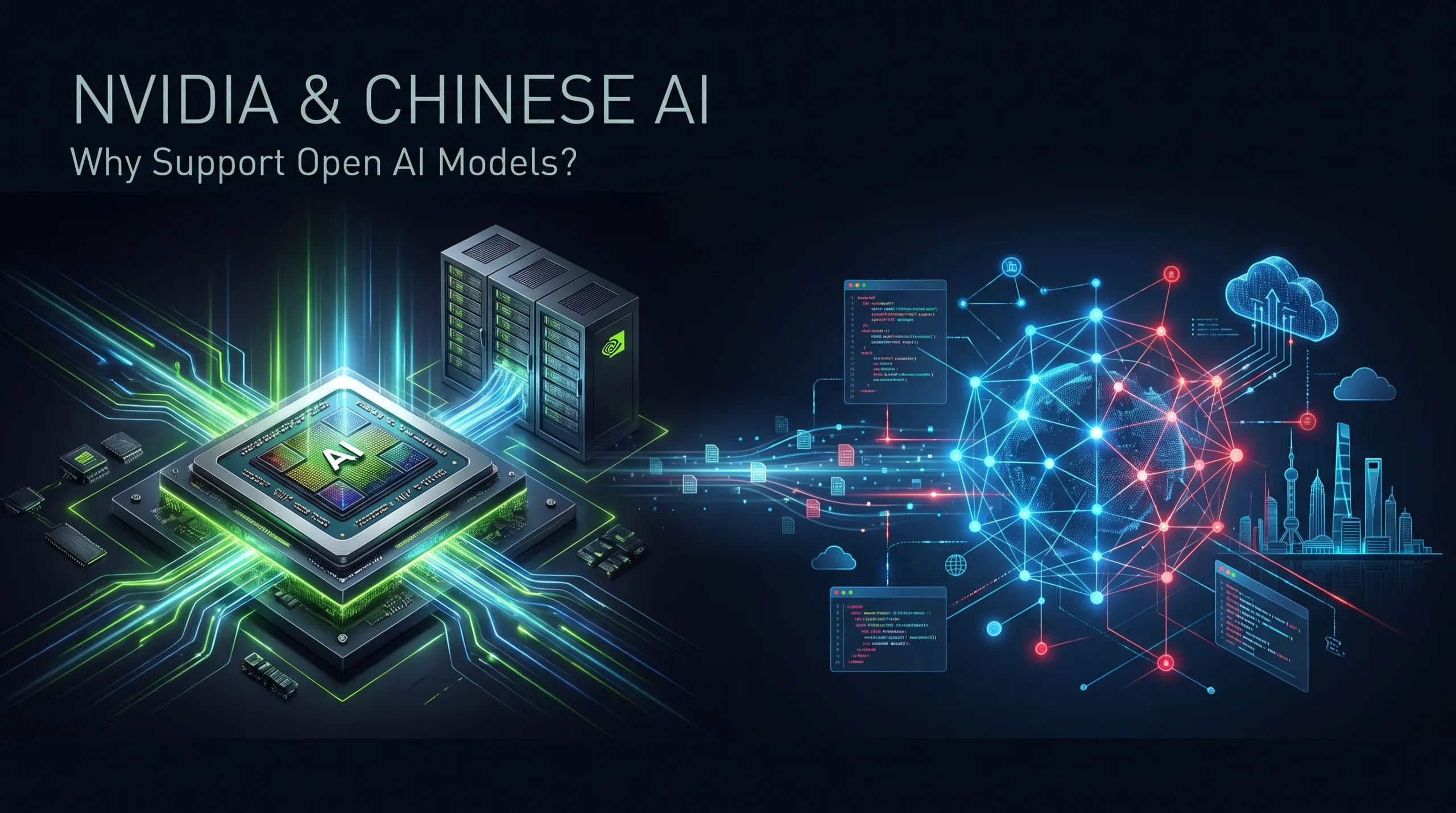
DeepSeek-R1 and Alibaba’s Qwen have made Chinese open-weight AI models impossible for NVIDIA to ignore. The answer to why is NVIDIA bolstering support for Chinese open AI models? comes down to software reach, inference demand, market access, and competition with Chinese chipmakers.
NVIDIA must follow U.S. export controls on advanced AI chips. Yet Chinese developers still build influential models that spread through cloud platforms, research labs, and enterprise software. Supporting those models does not mean NVIDIA supports every policy behind them. It means the company wants its tools to remain part of the workflow wherever AI development takes place.
Why Is NVIDIA Bolstering Support for Chinese Open AI Models?

Model support protects NVIDIA’s software position
NVIDIA’s business is much larger than GPU sales. CUDA, cuDNN, TensorRT, TensorRT-LLM, Triton, NeMo, and NIM help developers train, tune, optimize, and serve AI models.
That creates a strong reason to support popular model families. When developers run DeepSeek or Qwen through NVIDIA libraries, they learn NVIDIA workflows, build deployment scripts, and tune systems around CUDA-compatible hardware. The model may come from China, but the surrounding tools can still reinforce NVIDIA’s platform.
Support can mean many things. It may include optimized kernels, model conversion tools, quantization recipes, reference code, documentation, or a ready-to-run NIM container. NVIDIA’s DeepSeek model page lists TensorRT-LLM optimization, NIM deployment, and quantized DeepSeek-R1 options.
Open-weight models bring developers and buyers
“Open-source” and “open-weight” do not mean the same thing. An open-weight model makes its trained parameters available, while its training data, code, or license may remain limited. Buyers must still review each model’s terms.
DeepSeek-R1 was released on January 20, 2025. DeepSeek says its code and model weights use the MIT License, allowing commercial use, modification, and distillation. Its official repository also lists six smaller distilled models based on Qwen and Llama families.
Alibaba’s Qwen2.5 release in September 2024 included models from 0.5 billion to 72 billion parameters. Qwen says most versions use the Apache 2.0 license, while its 3B and 72B models have different terms. Its official documentation also names TensorRT-LLM among supported deployment tools.
These releases increase demand for the full serving stack around a model. Developers need GPUs, memory, networking, storage, monitoring, and low-cost inference. NVIDIA can benefit when its software helps make those deployments practical.
China Remains Important Despite AI Chip Export Controls

U.S. rules limit products, not every model
U.S. export controls focus on advanced computing capacity, chip performance, memory bandwidth, interconnects, end users, and related technology. The rules have changed several times, making China a difficult market for NVIDIA to serve.
In May 2025, the Bureau of Industry and Security rescinded the Biden-era AI Diffusion Rule and announced plans for a replacement. The same announcement warned about the use of U.S. AI chips for training and inference of Chinese AI models. That warning shows why model support and hardware sales must be treated as separate issues.
NVIDIA’s fiscal 2026 Form 10-K describes restrictions on A100, H100, H20, H200, and other products. It says NVIDIA recorded a $4.5 billion charge tied to H20 inventory and purchase obligations after the U.S. required an export license in April 2025.
Permitted hardware needs useful software
Export-compliant products have value only if customers can run the models they want. Model support helps Chinese developers get more performance from permitted systems, older NVIDIA hardware, or infrastructure located outside mainland China.
The path is still narrow. NVIDIA reported about $60 million in H20 revenue under licenses granted in August 2025. In January 2026, BIS said it would review H200 exports to China case by case, subject to security and compliance conditions.
NVIDIA’s filings also show the risk of losing the market. China, including Hong Kong, accounted for $19.7 billion in revenue in fiscal 2026, down from $25.0 billion in fiscal 2025. NVIDIA said export controls and Chinese policy had helped local rivals build larger developer and customer bases.
Chinese Open AI Models Increase the Value of Efficient Inference

DeepSeek made compute efficiency a central issue
DeepSeek’s technical work pushed attention toward efficient model design. DeepSeek-V3 and DeepSeek-R1 use a mixture-of-experts architecture with 671 billion total parameters and 37 billion activated parameters per token. That structure does not remove the need for large systems, but it changes how compute and memory are used.
DeepSeek-R1 also showed how reinforcement learning and distillation can create smaller reasoning models. Its repository lists distilled versions at 1.5B, 7B, 8B, 14B, 32B, and 70B sizes.
For NVIDIA, that creates a large inference opportunity. Smaller or more efficient models can fit into more systems and support more applications. Lower cost per request may encourage companies to run coding tools, search systems, agents, and customer services at higher volume.
Optimization ties inference to NVIDIA tools
Inference providers care about latency, throughput, memory use, and power costs. Techniques such as quantization, batching, tensor parallelism, expert parallelism, KV-cache management, and speculative decoding can improve those measures.
NVIDIA’s TensorRT-LLM deployment guide for DeepSeek-R1 covers FP8 and NVFP4 execution on Hopper and Blackwell hardware. It also includes settings for mixture-of-experts back ends, CUDA graphs, batching, and key-value cache capacity.
This is the business logic behind NVIDIA DeepSeek support. Each optimization can make NVIDIA hardware more useful for a major model family. It also gives NVIDIA data about real workloads, which can guide future chips and software.
NVIDIA Must Defend Its Position Against Chinese AI Hardware
Software skills create switching costs
Developers build knowledge around CUDA libraries, model-serving systems, performance tools, and production support. Teams also create internal code that depends on those tools.
Moving to another accelerator may require new kernels, new compilers, new monitoring systems, and new deployment tests. The hardware may be available, but the software change can slow production. By keeping DeepSeek and Qwen compatible with NVIDIA systems, NVIDIA keeps that technical habit alive.
Huawei and local chips raise the pressure
Chinese alternatives include Huawei Ascend and other domestic accelerator programs. They should not be treated as one group. Their performance, software support, supply, cloud access, and developer adoption differ by product and use case.
Still, the direction is clear. Reuters reported in April 2025 that Huawei was preparing a new AI chip for mass shipment as China sought alternatives to NVIDIA. BIS also issued guidance in May 2025 about PRC advanced computing chips, including Huawei Ascend products.
NVIDIA can lose direct chip sales while still preserving influence through model tools. That influence matters if developers later work in other countries, use global cloud services, or return to NVIDIA hardware when export rules change.
The NVIDIA China AI Strategy Carries Real Risks

Compliance can change without warning
Supporting a public model does not authorize the sale of restricted chips or services. NVIDIA must also consider cloud access, end-use rules, customer screening, software support, and possible diversion.
The company’s 10-K warns that new controls could affect products, networking systems, AI cloud services, and support for third-party models originating in China. It also says China’s government has discouraged customers from buying NVIDIA data center products, including China-specific products designed for U.S. compliance.
Political scrutiny can limit technical support
U.S. officials may view optimization work, cloud access, or large-scale deployment support as part of China’s AI capacity. Chinese regulators may also view restricted NVIDIA products as unreliable or politically risky.
That creates uncertainty for developers and investors. A model may be openly available, but its best deployment path can still depend on export rules, tariffs, local approvals, and vendor support.
What This Means for Developers and Investors
Developers should test more than benchmark scores. Check CUDA, ROCm, major cloud platforms, Chinese accelerators, serving frameworks, quantization quality, memory use, latency, and total cost.
Enterprises should separate model openness from deployment safety. Review the license, data terms, model updates, security record, content controls, and support commitments before using a model with sensitive data.
Investors should watch software adoption as well as GPU revenue. Useful signals include NVIDIA’s TensorRT-LLM and NIM model support, cloud integrations, China-related filings, domestic accelerator adoption, networking demand, and growth in open-weight inference.
Conclusion
NVIDIA is supporting Chinese open AI models because the company is defending more than its China business. It is protecting CUDA adoption, selling the tools needed for efficient inference, keeping access to a major AI market, and slowing the shift toward local Chinese hardware.
Export controls still limit advanced chip sales. NVIDIA cannot offer unrestricted access to its newest systems, and its fiscal 2026 filing shows how costly policy changes can be. Yet model support keeps NVIDIA present in the technical workflows that shape AI development.
The next contest will involve more than model quality. It will also involve the tools, chips, cloud systems, networks, and developer skills used to run those models.
FAQS
Jensen Huang co-founded Nvidia in 1993, but the company has since issued shares to employees, investors, and the public to fund growth. His reported beneficial ownership was approximately 870.6 million shares, or 3.58%, as of March 23, 2026. That figure may include shares associated with family trusts or foundations, not necessarily shares he personally controls for economic benefit.
A 3% stake is still exceptionally valuable because Nvidia became one of the world’s largest companies. Huang also retains major influence through his role as co-founder, president, CEO, and board member.
The leading Chinese competitors include:
Huawei, with its Ascend AI accelerator and Atlas systems.
Cambricon, which develops MLU processors for AI workloads.
Baidu’s Kunlunxin, focused on chips for training and inference.
Alibaba’s T-Head, which develops its own AI accelerator technology.
Biren, Moore Threads, MetaX, Hygon, and Iluvatar CoreX.
Huawei is generally viewed as the strongest domestic alternative, while China’s broader chip industry includes several companies competing across training, inference, graphics, and specialized acceleration.
It is possible, but no one can know with certainty. Several analysts raised their Nvidia price targets to $300 after strong results, while some published targets were higher; this shows that $300 is within the range of current market expectations, not a guaranteed outcome.
The stock could be supported by continued AI infrastructure spending, strong data-center demand, and Nvidia’s software ecosystem. Risks include high valuation, export restrictions, competition from AMD and Chinese chipmakers, customer spending changes, supply limitations, and broad market volatility. This is not a prediction or personalized investment advice.
Not as a complete, permanent ban on every Nvidia AI chip. The situation is more complicated: U.S. export controls restrict Nvidia’s most advanced chips from being shipped to China, while Beijing has also limited or scrutinized the use of certain foreign accelerators to support domestic suppliers. In 2026, small batches of Nvidia H200 chips were reportedly allowed into mainland China under specific approvals, so saying that China has banned all Nvidia AI chips is inaccurate.
Availability can vary by chip model, customer, license, and current Chinese or U.S. policy.
Most major Google consumer services remain blocked or heavily restricted on mainland China’s ordinary domestic internet. This commonly includes Google Search, Gmail, Google Maps, YouTube, Google Drive, and Google Play, although some Google websites or services may work intermittently or in special circumstances.
This does not mean Google is banned everywhere in the Chinese-speaking world: mainland China, Hong Kong, and Macau have different internet-access conditions.
Jensen Huang is a Taiwanese-American technology executive. He was born in Tainan, Taiwan, later lived in Thailand, and moved to the United States as a child; he is the co-founder, president, and CEO of Nvidia. Describing him simply as “Chinese” is therefore imprecise—“Taiwanese-American” is the more accurate description.


One Comment on “Why Is NVIDIA Bolstering Support for Chinese Open AI Models?”
Comments are closed.