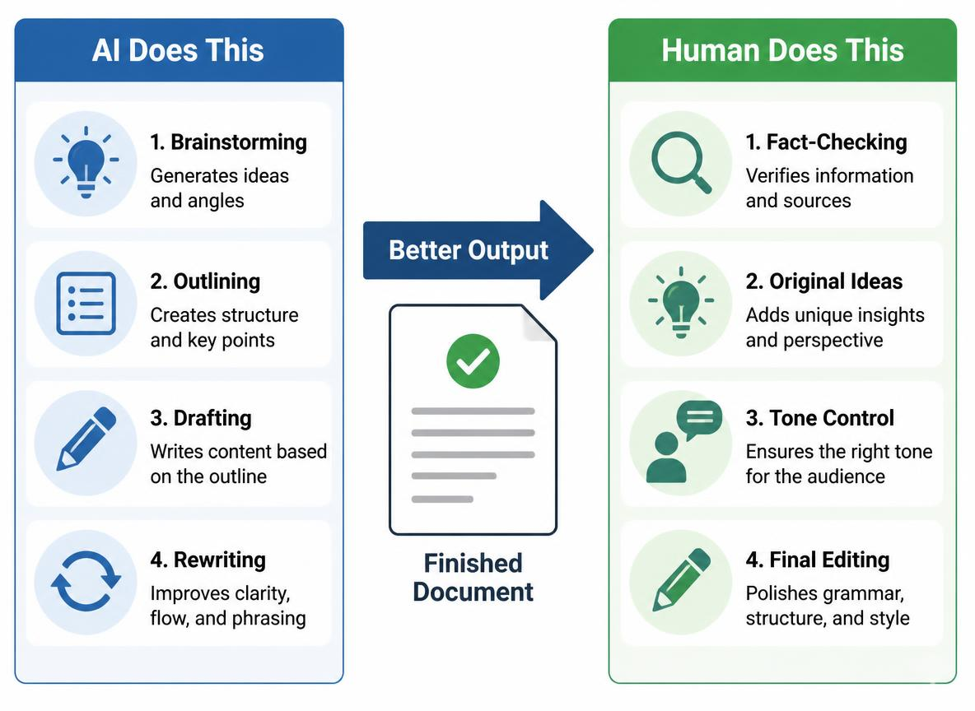
AI is changing how freelancers perform everyday digital work. But simply knowing ChatGPT or another AI tool is not a freelance service. International clients pay for useful outcomes and professional skills. This article explains 7 AI-Powered Freelance Services Beginners Can Sell to International Clients, add human judgment and quality control, and package that skill as a service. We’ll cover seven AI-assisted services: content writing, social media content, graphic design, short-form video, virtual assistance, customer support automation, and digital marketing. Each section explains what you can offer, what skills you need, how AI helps, and where human value remains essential.
The freelance market has shifted dramatically. Employers posting jobs on major platforms now expect candidates to know how to use generative AI tools. According to recent data from Upwork, AI-related skills are among the fastest-growing categories on the platform, with AI video generation and editing up 329% year over year, followed by AI image generation at 95% and AI chatbot development at 71%. Meanwhile, social media strategy grew 36% year over year, and general virtual assistance remains one of the most in-demand services. This data tells a clear story: clients want AI-capable freelancers, but they want them for specific, practical outcomes—not because they’re fascinated by the technology itself.
The freelancers who succeed are those who understand a fundamental principle: AI is a tool, not a service. A hammer is not a house. A paintbrush is not a painting. ChatGPT is not a blog post that ranks, converts, or builds trust with readers. The tool accelerates work, but the professional judgment, domain knowledge, and quality control come from you. This article will show you how to develop those capabilities across seven service areas and turn them into a sustainable freelance practice serving international clients.
Also Read: Laptop Buying Guide for Freelancers: CPU, RAM, SSD and Display Explained
1. AI-Assisted Content Writing and Editing

Content writing remains one of the most accessible entry points for beginners. The demand for written content—blog posts, website copy, product descriptions, email newsletters—continues across industries. Every business with a website needs words. Every company sending emails needs someone to write them. Every online store needs product descriptions that inform and persuade.
What separates paid work from hobby writing is the ability to research thoroughly, write clearly, and edit ruthlessly. Clients aren’t paying for words; they’re paying for communication that achieves specific goals—educating customers, ranking in search results, building brand authority, or driving conversions.
What beginners can offer: Blog posts, website copy, product descriptions, email newsletters, editing and proofreading.
Skill required: Writing, research, grammar, editing, basic SEO.
How AI helps: Brainstorming ideas, creating outlines, drafting sections, rewriting awkward passages, summarizing research.
Human value: Fact-checking claims, generating original ideas, maintaining appropriate tone and accuracy, and performing final editing that catches what AI misses. Research consistently shows that nearly all workers verify and revise AI-generated content before using it, indicating that human review remains essential. AI can produce fluent text, but it cannot verify facts, understand nuanced brand voice, or make strategic decisions about what to include and what to omit.
Beginner example: A freelancer specializing in technology could offer blog writing to small SaaS companies, using AI to accelerate research and drafting while applying domain knowledge to create genuinely useful content. A freelancer with a background in health and wellness might serve supplement brands, using AI to organize research while applying subject-matter expertise to ensure accuracy and compliance.
The key is specialization. A generalist writer competing on price will struggle. A writer who understands a specific industry—fintech, healthcare, e-commerce, B2B software—can charge premium rates because they bring context that AI lacks.
Also Read: 7 Best AI Writing Tools for American Freelancers to Scale Their Websites
2. AI-Powered Social Media Content Services
Social media management requires a blend of creativity, strategy, and consistency. Businesses need regular content but often lack the time or expertise to maintain an active presence across platforms. A restaurant owner knows food but may not know how to write captions that stop scrolling. A fitness coach understands training but may not know how to structure a content calendar that builds an audience over time.
What beginners can offer: Social-media captions, content calendars, post ideas, short-form scripts, content repurposing.
Skills required: Copywriting, social-media strategy, audience research, basic analytics.
How AI helps: Generating post ideas, creating caption variations for A/B testing, organizing content calendars, repurposing existing content into different formats.
Human value: Understanding the target audience’s preferences and pain points, maintaining brand voice consistently, and deciding what content should actually be published. AI can generate fifty caption variations, but it cannot determine which one aligns with a brand’s personality or which topic will resonate with a specific audience segment. That requires human judgment informed by audience research and platform knowledge.
Consider a practical scenario. A freelance social media manager working with a wellness brand might use AI to generate ten caption options for an Instagram post about morning routines. But the human decides to lead with a question that addresses a common struggle—”Tired of hitting snooze three times?”—rather than a generic statement because they understand the audience’s daily frustrations. The AI provides raw material. The human provides strategy.
Social media strategy is among the fastest-growing skills employers seek, growing 36% year over year according to Upwork data. This suggests that businesses recognize they need strategic thinking, not just content production.
3. AI-Assisted Graphic Design
Design services remain in high demand despite AI image generation tools. The key distinction is that AI generates assets, but humans make design decisions. A client doesn’t need “an image.” They need a thumbnail that increases click-through rates, a social graphic that communicates a promotion clearly, or a presentation that persuades investors.
What beginners can offer: Social-media graphics, YouTube thumbnails, simple advertisements, presentation graphics, blog visuals.
Skills required: Design principles, typography, layout, branding, basic image editing.
How AI helps: Generating initial concepts, creating multiple visual variations quickly, removing backgrounds, speeding up repetitive tasks.
Human value: Making design decisions based on strategy and brand guidelines, ensuring brand consistency across deliverables, editing AI outputs to professional standards, and understanding the client’s brief beyond surface requirements. AI image generation and editing skills are among the fastest-growing categories, up 95% year over year, indicating strong market demand for professionals who can leverage these tools effectively.
The human designer’s value lies in understanding why one design works and another doesn’t. AI can generate a hundred logo concepts in minutes. A skilled designer knows that a logo needs to work at different sizes, in different contexts, in black and white as well as color, and that it needs to communicate the right associations for the brand. That’s judgment, not generation.
Beginner example: A freelancer could specialize in YouTube thumbnails for gaming channels, using AI to generate background concepts while applying knowledge of what visual elements drive clicks in that specific niche. Another might focus on presentation design for startups preparing investor decks, where clarity and professionalism matter more than artistic flair.
4. AI-Assisted Short-Form Video Services
Short-form video has become essential for social media reach. TikTok, YouTube Shorts, and Instagram Reels require constant content production, creating demand for editors who can work efficiently. A single podcast episode can generate fifteen short clips. A webinar can produce twenty. A product launch can yield dozens of promotional videos. The volume is overwhelming for businesses without dedicated editors.
What beginners can offer: TikTok videos, YouTube Shorts, Instagram Reels, podcast clips, content repurposing.
Skills required: Video editing, storytelling, hook writing, pacing, captions.
How AI helps: Transcription of spoken content, caption generation, identifying potential clips from longer content, script assistance, repurposing existing footage.
Human value: Choosing the strongest moments from raw footage, crafting narratives that hold attention, making editing decisions that serve the story, and understanding what resonates with the target audience. AI video generation and editing is the single fastest-growing skill category on Upwork, up 329% year over year, reflecting explosive demand for this expertise.
The difference between a video that gets 500 views and one that gets 500,000 often comes down to the first three seconds. AI can transcribe a two-hour podcast and suggest timestamps. But the human editor knows which moment will make someone stop scrolling—the controversial statement, the surprising statistic, the emotional story. That’s storytelling judgment, and it’s what clients pay for.
Beginner example: A freelancer could specialize in podcast clips for business podcasts, using AI transcription to quickly identify promising segments, then applying editing skills to create polished clips with captions, proper pacing, and hooks that work on specific platforms.
5. AI-Assisted Virtual Assistance and Online Research
Virtual assistance covers a broad range of administrative and research tasks that businesses need but don’t want to handle internally. The work requires organization, reliability, and attention to detail. It’s not glamorous, but it’s consistent, and many clients need ongoing support rather than one-off projects.
What beginners can offer: Web research, data organization, email assistance, document preparation, lead research, meeting summaries.
Skills required: Organization, research, communication, attention to detail, spreadsheet skills.
How AI helps: Summarizing information quickly, organizing research findings, drafting routine communications, processing large amounts of information.
Human value: Checking accuracy of AI outputs, organizing information logically for the client’s needs, communicating professionally with clients, and handling tasks that require judgment rather than pattern matching.
Virtual assistance is often underestimated as a freelance service because it seems simple. But the best virtual assistants save clients hours of work each week and become indispensable. They anticipate needs, communicate proactively, and handle details reliably. AI makes them faster, but it doesn’t make them trustworthy. Trust is built through consistent human performance.
Beginner example: A freelancer could offer lead research services to B2B sales teams, using AI to gather initial data on potential prospects while applying human judgment to qualify leads based on criteria that matter to the specific business.
6. AI-Powered Customer Support and Chatbot Setup
Small businesses increasingly want automated customer support but lack the technical expertise to implement it effectively. They’ve heard about chatbots and AI assistants but don’t know how to set them up or train them on their specific products and services. This creates opportunities for freelancers who understand both customer service and basic automation.
What beginners can offer: FAQ automation, basic chatbot setup, automated customer responses, knowledge-base organization, customer enquiry workflows.
Skills required: Customer service, communication, basic automation, understanding business workflows.
How AI helps: Answering common questions, categorizing enquiries, drafting responses, automating repetitive conversations.
Human value: Designing the workflow to match business needs, knowing when customers need a human touch, checking AI responses for accuracy and tone, and handling sensitive or complex enquiries. AI chatbot development grew 71% year over year, reflecting growing demand for implementation expertise.
A chatbot that handles password reset requests is useful. A chatbot that misinterprets a billing complaint and responds with a generic FAQ is a disaster. The human designer’s job is to understand which conversations can be automated, which require escalation, and how to structure the entire system so customers feel helped rather than frustrated.
Beginner example: A freelancer could specialize in setting up customer support automation for e-commerce stores, designing chatbots that handle order tracking and return questions while ensuring complex issues reach a human quickly.
7. AI-Assisted Digital Marketing Services
Digital marketing encompasses many specializations, from SEO to email marketing. Beginners can start with narrower offerings and expand as they gain experience. The field is broad enough that there’s room for specialists in many areas.
What beginners can offer: Content planning, keyword research, competitor research, email marketing assistance, lead-generation support, basic SEO support.
If you’re starting from scratch, this guide on how to become a digital marketer with no experience walks through the fundamentals step by step.
Skills required: Marketing fundamentals, copywriting, research, SEO, basic analytics.
How AI helps: Research assistance, brainstorming campaign ideas, creating content drafts, organizing data, generating campaign variations.
Human value: Developing marketing strategy, understanding customer psychology, evaluating data critically, making decisions about what to test and scale, and measuring results against business objectives.
Important point: Don’t promise clients guaranteed sales, leads or revenue. Marketing involves many variables beyond your control—market conditions, product quality, pricing, competition. Promise effort, process, and deliverables—not outcomes. This protects you legally and professionally, and it builds trust with clients who understand that marketing is an investment with uncertain returns.
Beginner example: A freelancer could offer SEO support to local service businesses, using AI to research keywords and analyze competitors while applying marketing judgment to prioritize opportunities and create content that actually serves the business’s goals.
How Beginners Can Turn These Skills Into a Freelance Service

Step 1: Choose one service. Don’t try to offer all seven. Pick the one that best matches your existing strengths and interests. If you enjoy writing, start with content. If you’re visually oriented, focus on design. If you’re organized and detail-oriented, virtual assistance might be your path. Spreading yourself thin across multiple services makes you mediocre at all of them and memorable for none.
Step 2: Learn the underlying skill. AI should complement the skill, not replace it. If you choose content writing, become a better writer. Study grammar, read widely, practice consistently. If you choose design, learn the principles that make designs effective. The tool doesn’t make the professional. A novice with a professional camera still takes amateur photos. A novice with AI still produces amateur work.
Step 3: Choose a specific client. Generalists struggle. Specialists thrive. Instead of offering “content writing,” offer “blog writing for SaaS companies.” Instead of “graphic design,” offer “YouTube thumbnails for gaming channels.” Consider restaurants, coaches, SaaS companies, e-commerce stores, YouTubers, or small businesses. Choose one and learn everything you can about their needs.
Step 4: Create 2–3 sample projects. Use clearly labelled practice or spec projects if you don’t have clients yet. Demonstrate your process and results. A spec project is a piece of work you create for a fictional or real business without being hired. It shows what you can do. Label it clearly as practice or spec work so you’re being honest, but don’t be shy about using it to demonstrate your capabilities.
Step 5: Create a simple portfolio. A personal website, LinkedIn, Notion, Google Drive, or Behance (where appropriate) works fine. Keep it focused on your chosen service. Three excellent samples beat ten mediocre ones. Include a brief description of the project, the challenge, and your solution.
Step 6: Start outreach. Use freelance platforms, LinkedIn, direct email, and professional communities. Personalize every message. Sending a hundred generic proposals wastes your time and annoys potential clients. Sending ten thoughtful, specific proposals gets results.
How to Find International Freelance Clients
International clients are accessible through several channels. Upwork and Fiverr provide marketplace-based work where clients come looking for services. LinkedIn enables direct professional networking and outreach. Direct outreach to businesses that need your service—cold email, social media messages—can work well with personalization. Referrals from satisfied clients or professional contacts remain the highest-quality source of new business.
If you’re new to Upwork, this step-by-step guide on how to start Upwork with no experience covers profile setup, proposals, and getting your first job.
Personalize proposals rather than sending mass messages. Instead of saying “I am an AI freelancer,” explain the specific problem you can solve. For example: “I noticed your blog hasn’t been updated in three months. I specialize in helping SaaS companies maintain consistent content that ranks for keywords their customers search.” This approach demonstrates that you’ve done your homework and understand their business, which immediately distinguishes you from the many generic proposals they receive.
Warnings: Never pay to receive a job. Fake clients often request registration fees or security deposits. Be suspicious of clients who request personal information, passwords, or banking details before any work begins. Ignore unrealistic income promises—either from clients or from anyone selling you a course. Legitimate clients pay you. They don’t ask you to pay them.
Conclusion
Don’t sell AI. Sell a useful skill that AI helps you deliver better. Choose one service. Develop the underlying skill. Build a portfolio that demonstrates your abilities. Use AI responsibly as a productivity tool, not as a replacement for judgment. Start contacting potential clients with personalized outreach. The opportunity is real, but it belongs to those who put in the work.
The freelancers who thrive in this new landscape will be those who combine human expertise with AI efficiency. They’ll be better writers who use AI to draft faster, better designers who use AI to iterate quickly, better marketers who use AI to analyze data. The technology amplifies skill; it doesn’t substitute for it. Choose your service, develop your craft, and start building.
Sources
- Upwork — In-Demand Skills 2026: A Market View of Skills Demand in an AI Economy
- Upwork — How to Become a Freelancer in 2026: Your Guide to Upwork
- Fiverr — Using AI on Fiverr: Guidelines for Freelancers and Clients
FAQS
Yes, but income depends on skill, service quality, client demand, and your ability to find and retain clients. AI improves productivity, but it doesn’t replace the need for competence, reliability, and client acquisition. Some freelancers earn modest part-time income. Others build full-time businesses. The difference lies in skill development, professionalism, and persistence.
No. You need to understand the service you’re providing and learn how AI can support your workflow. The focus should be on mastering the underlying skill—writing, design, marketing—and using AI to work more efficiently. You don’t need to understand how large language models work. You need to understand how to use them effectively for specific tasks.
There isn’t one universal answer. Choose based on your existing skills, genuine interests, and observable market demand. Check job postings on freelance platforms to see what clients actually pay for. If you have a background in education, content writing for edtech companies might be a natural fit. If you’re artistic, design services might suit you better.
Yes, with responsibility. Always review and edit AI outputs. Verify facts. Ensure originality. Follow client requirements and platform policies. Using AI as a drafting assistant is different from delivering unedited AI output as finished work. Clients are paying for your judgment, not just your access to tools.
Marketplaces (Upwork, Fiverr), LinkedIn, direct outreach, and referrals are the primary channels. Start with one channel and do it consistently before expanding. Many successful freelancers built their businesses primarily through one platform before diversifying. Master one channel first.


