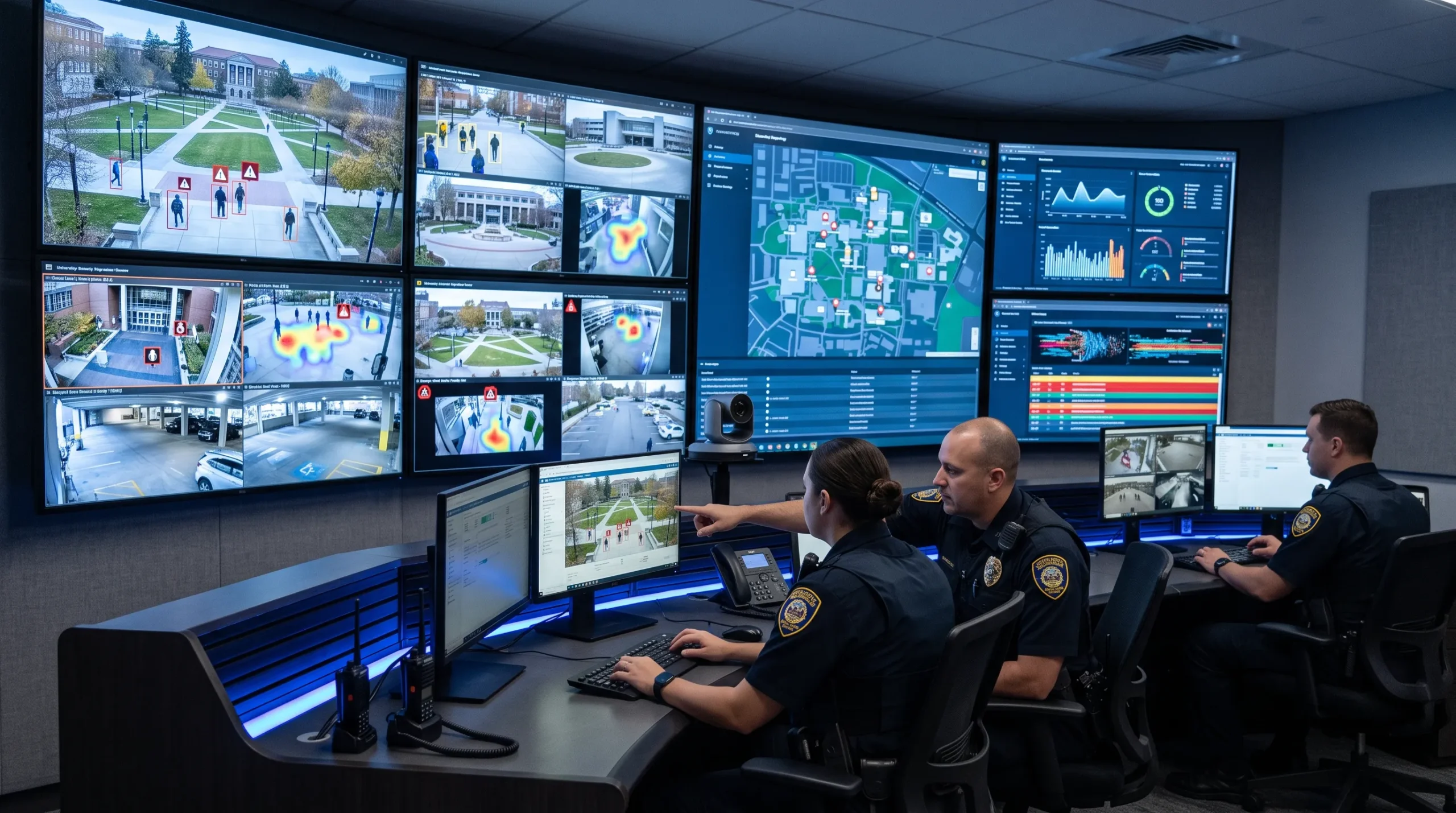
Every school morning starts the same way: hundreds or thousands of students arrive within the same twenty minutes, through a handful of doors. Traditional security was not built for that moment. A metal detector creates a queue and needs staff to wand everyone it flags. A camera system records everything but relies on a human noticing the one frame that matters, among dozens of feeds, in time to act.
AI weapon detection software closes that gap in two forms: walk-through scanners that screen students for concealed weapons as they enter, and camera software that watches existing feeds for a visible gun and alerts staff within seconds. Neither replaces guards, locked doors, or a good emergency plan. Used properly, they buy the thing that matters most in a violent incident — time.
This guide explains how both types work, compares the leading products, sets out realistic costs, and covers the limitations honestly — including the false alarms and missed weapons that have made headlines.
How AI Weapon Detection Works
The phrase covers two quite different technologies that solve different problems and cost different amounts; many districts eventually layer both. The same pattern-recognition principle powers each: models trained on large libraries of weapon images and sensor data, as in how AI is used in cybersecurity — except here the output is a physical alert at a door or on a camera feed, not a blocked login.
Type 1: Walk-Through Concealed Weapons Detection
Walk-through systems are the AI-era answer to the metal detector. Students pass between two slim panels at a normal walking pace, without emptying pockets or opening bags. Instead of simply detecting metal — why conventional detectors alarm constantly on laptops and binders — these systems combine low-frequency electromagnetic sensors with AI trained to recognise the size, shape, and material signature of firearms, larger knives, and explosive components.
When an object matches a weapon profile, the system alerts the operator and shows where on the person or in which bag it sits, so staff can run a targeted secondary check instead of searching everyone. Vendors quote throughput up to roughly 3,600 people per hour per lane — around ten times a traditional detector lane — making it feasible to screen a whole student body before first period.
The trade-off is sensitivity: turn it up and the system catches more small knives but flags far more harmless items; turn it down and some weapons slip through. That dial sits at the centre of most controversy in this category, as the limitations section explains.
Type 2: AI Gun Detection on Existing Cameras
The second type adds no hardware at the door. It is software that plugs into the digital cameras a school already owns and analyses video in real time, looking for one thing: a visibly brandished firearm. It cannot see a gun hidden in a backpack — its job is to catch the moment a weapon comes out, often minutes before the first shot in a planned attack.
Because a false alarm from software alone could trigger a lockdown or armed police response, the leading platforms route every detection to a human first. With ZeroEyes, a still image goes to its US-based operations centre, staffed around the clock by trained analysts — many of them military and law-enforcement veterans — who verify it is a real gun. Only then does the alert reach staff and law enforcement, with a photo, weapon type, and camera location, typically within seconds. Omnilert offers a similar verification step, then ties confirmed alerts into automated notifications, PA announcements, and door locking.
What Happens After an Alert
Detection is only the first link in the chain. A verified alert should automatically notify staff and law enforcement with an image and location, trigger the emergency plan (lockdown, PA announcements, mass notifications), operate pre-set door locks, and log the event. If a vendor cannot integrate with your existing notification and access-control systems, you are buying an alarm bell, not a response system.
Top AI Weapon Detection Systems Compared
Five names dominate US school deployments: two walk-through screening systems, two camera-analytics platforms, and the advanced metal detector many schools still choose as a baseline.
| System | Type | How it works | Best for | Pricing model |
|---|---|---|---|---|
| Evolv Express | Walk-through scanner | Free-flow panels use sensors and AI to distinguish weapons from phones, keys, and laptops at normal walking pace; alerts show the threat location on a tablet | Large schools that must screen every student, every morning, without queues | Multi-year subscription (typically 4 years) covering hardware, software, and support, or purchase plus an annual software fee |
| Athena Security Weapons Detection System | Walk-through scanner platform | Pairs CEIA OPENGATE (also Garrett or Metrasens) detectors with an iPad platform that pinpoints where a suspected weapon is, flags screening evasion, and can add AI X-ray bag scanning | Schools that want screening built around Department of Homeland Security best practices, with strong audit and compliance reporting | Quote-based purchase via integrator partners; Lamar Consolidated ISD in Texas installed 24 systems |
| ZeroEyes | Camera analytics | Software layer on existing digital cameras detects visible firearms; every detection is human-verified in its 24/7 operations centre before alerts go out | Schools with good camera coverage that want earlier warning of a brandished weapon, indoors and outdoors | Annual subscription priced per connected camera; no new door hardware |
| Omnilert Gun Detect | Camera analytics + response platform | AI analyses existing camera feeds for visible guns; detections are verified by monitoring-centre operators or your own team, then trigger automated notifications, lockdowns, and workflows | Districts that want detection and emergency communication in one platform | Per-camera annual subscription, quote-based; often bundled with Omnilert’s notification platform |
| Garrett Paragon | Advanced walk-through metal detector (non-AI baseline) | Multi-zone electromagnetic detection with modern discrimination settings; no AI object recognition, so staff resolve far more alerts manually | Smaller schools with a tight budget, one entrance, and staff for secondary screening | One-time hardware purchase per lane, plus optional service plans |
One credential worth knowing: ZeroEyes, Omnilert, and Evolv all hold US Department of Homeland Security SAFETY Act designations, which matters for procurement and liability — but it is not a guarantee of performance.
What Does AI Weapon Detection Cost?
Almost no vendor publishes a price list, so the figures below come from public district proposals, contracts, and industry reporting. Treat them as planning ranges, not quotes.
Walk-through screening
A conventional metal detector lane costs roughly $5,000. AI screening costs far more. Public proposals for Evolv Express show single-lane hardware at around $30,000 per unit purchased outright (dual-lane list prices are reported up to about $60,000), plus a software subscription — one recent district proposal priced it at roughly $48,850 per lane across a four-year term. Many districts instead lease, which industry reporting puts at roughly $2,000–$3,000 per lane per month, covering hardware, software, maintenance, and updates. Athena sells on quotation through integrators; expect the same order of magnitude.
Camera analytics
Camera-based platforms are priced per connected camera, per year, which makes your camera count the whole ballgame. Sarasota County Schools in Florida reportedly invested about $917,000 for a first-year Omnilert deployment across its middle and high schools, and Baltimore County Public Schools signed a three-year, $2.6 million contract covering roughly 7,000 cameras. One school with 40–80 cameras lands far below those totals — but get the per-camera rate, verification cost, and renewal uplift in writing.
The costs people forget
- Staffing. Every alert needs a trained person to run the secondary check. Budget for staff at each lane, every morning — often the largest long-term cost.
- Camera upgrades. Analytics platforms need decent digital cameras, sensibly placed. Analogue cameras, blind spots, and poor lighting mean upgrade spending first.
- Training and drills. Initial training, refreshers, and a place in your existing drill schedule.
- Contract renewals. Negotiate renewal caps at signing, not at expiry, or year-five pricing can erase the bargain.
The offsetting good news: this is a grant-friendly category. Many states run dedicated safety programmes — Kansas funds firearm-detection deployments through its Safe and Secure Firearm Detection Grant Program — and federal school safety grants routinely cover both system types.
Benefits of AI Weapon Detection in Schools
- Earlier warning. Camera analytics can flag a visible gun in the car park or corridor and put a verified alert in staff hands within seconds — potentially minutes before an incident begins, when lockdowns do the most good.
- Screening without the bottleneck. Walk-through systems move students at walking pace, so everyone is screened without airport-style queues.
- Fewer nuisance alarms than metal detectors. Because the AI classifies objects rather than reacting to any metal, phones and keys pass without an alert — though real-world performance varies, as the next section shows.
- A deterrent and an audit trail. Visible screening changes behaviour at the door, and every alert is logged for incident review and board reporting.
Limitations and Controversies: Read This Before You Buy
This technology is genuinely useful and genuinely imperfect, and vendor marketing has not always kept that distinction clear. Three issues deserve a school board’s full attention.
The false-positive / missed-weapon trade-off
In November 2024, the US Federal Trade Commission took action against Evolv, the category’s largest vendor, alleging it had overstated what its scanners could do — including claims they would detect all weapons and ignore harmless items. The complaint described scanners that flagged laptops, binders, and water bottles in schools, and in one October 2022 case failed to detect a seven-inch knife later used to stab a student; when that school raised sensitivity afterwards, its false-alarm rate hit roughly 50 percent. Under the settlement, Evolv is barred from making unsupported detection claims, and some school customers were offered a route out of their contracts. Evolv reports alert rates around 2 percent in K-12 settings, but the lesson stands: detection rate and false-alarm rate are two ends of one dial, and any quote giving you only one number is incomplete.
Camera analytics have their own version of the problem. In a widely reported October 2025 incident at Kenwood High School in Baltimore County, an Omnilert system flagged a student’s bag of chips as a possible gun; police responded and the student was handcuffed before the error was cleared. The district argued the system worked as designed — it alerted humans, who verify — but the event shows why verification and your alert-cancellation protocol matter as much as the AI. Conversely, after the January 2025 shooting at Antioch High School in Nashville, questions and litigation focused on the opposite failure: the gun was not flagged in time, with camera distance and coverage cited as factors. A camera system only sees what its cameras see.
Privacy and student trust
Parents will ask, reasonably, what else the system watches. The reassuring facts: the leading camera platforms detect objects, not identities — ZeroEyes and Omnilert state they do not use facial recognition, and verifiers review flagged frames, not live feeds. Even so, publish a clear policy on what is recorded, how long alert images are kept, who can see them, and how the data is protected — a breach would be damaging in exactly the way we describe in our guide to AI phishing attacks, where one compromised account can expose an entire organisation.
It is one layer, not a solution
No scanner screens every entrance at all hours, and no camera platform detects a concealed weapon. These systems belong in a layered approach — controlled entry, visitor management, trained staff, threat assessment, and a culture where concerns get reported early. Physical safety also sits alongside digital safety in a school’s duty of care, from AI-generated scams and deepfakes to cyberbullying. Technology at the door is the visible part of safety, not the whole of it.
Deployment Checklist for Schools
- Map your risks and entry points first. Count entrances, arrival surges, camera positions, and blind spots. The map decides which system you need.
- Decide the layer you are buying. Door screening (walk-through), campus-wide early warning (camera analytics), or both.
- Demand both numbers. Require the detection rate and false-alarm rate, in writing, at the sensitivity you will actually run — in real schools, not lab tests.
- Run a pilot on your own site. Test with your students, your bags, your lighting, and your busiest twenty minutes. Record every alert.
- Check integrations. Confirm it connects to your mass notification, PA, access control, and cameras — and what happens automatically in the first 30 seconds of an alert.
- Plan the human side. Staff every lane, train operators, write the verification and cancellation protocol, and drill with the system live.
- Write the privacy policy before installation. Cover data retention, access, facial recognition (off or absent), and parent communication.
- Read the contract like a sceptic. Term length, renewal caps, cancellation rights, and performance commitments.
- Apply for grants early. State and federal safety funding can cover much of the cost, but windows are fixed.
- Review after 90 days. Audit alert logs, tune sensitivity and camera placement, and report results to the board.
Frequently Asked Questions
Can AI weapon detection replace metal detectors?
For many schools, yes — that is the main reason to buy one: it screens at walking pace and classifies objects instead of alarming on all metal. But it depends on your alert staffing and sensitivity settings. Some schools keep wands for secondary screening, and camera analytics never replace entry screening, because they only detect visible weapons.
Does AI gun detection work with a school’s existing cameras?
Generally yes, provided they are digital (IP) cameras with reasonable resolution and placement. ZeroEyes and Omnilert are both built to layer onto existing networks. Expect a site survey first: analogue or badly aimed cameras will need upgrading or moving before the software can do its job.
How much does AI weapon detection cost for one school?
There is no list price, but public contracts give a range. A walk-through lane on subscription is reported at roughly $2,000–$3,000 per month; buying outright starts around $30,000 per lane plus an annual software fee. Camera analytics are priced per camera per year, so one school with a few dozen cameras typically pays a five-figure annual sum. Budget staffing and training on top.
Do these systems use facial recognition or record students?
The leading platforms are object-detection systems: they look for weapons, not faces. ZeroEyes and Omnilert both state they do not use facial recognition, and verifiers only see flagged frames. Confirm this in the contract, and publish your retention policy for stored alert images.
How accurate is AI weapon detection, really?
Accurate enough to be useful, not accurate enough to trust blindly. The FTC’s 2024 case documented missed weapons and high false-alarm rates at aggressive settings, while vendors report low alert rates in normal operation. Performance depends on sensitivity, coverage, and environment — so a pilot on your own campus is the only accuracy test that should drive a purchase.
Conclusion
AI weapon detection gives schools two things traditional security struggles to provide: screening that keeps up with the morning rush, and a verified warning within seconds when a gun appears on camera. The leading systems — Evolv and Athena at the door, ZeroEyes and Omnilert on the cameras — operate at scale in hundreds of districts, and safety grants often cover part of the cost.
Buy it with clear eyes. The FTC has sanctioned one vendor for overclaiming, false alarms have put innocent students in handcuffs, and a concealed weapon remains invisible to camera software. Treat AI detection as one strong layer in a wider safety programme — measured in a pilot, governed by a written privacy policy, reviewed against its own alert logs — and it can earn its place.


One Comment on “AI Weapon Detection Software for Schools: How It Works, Costs & Top Systems Compared”
Comments are closed.