AI weapon detection in schools is sold as a way to buy time. When a gun appears on campus, seconds decide what happens before the first call for help — and these systems promise to start that clock earlier. What they deliver depends on which technology you choose, how your buildings are laid out, and how carefully you read the contract.
This guide explains how both approaches work, what they cost once the hidden line items are counted, and where the honest debates sit: false alarms, privacy, a thin evidence base. For the vendor-by-vendor comparison, see our pillar guide to AI weapon detection software for schools. This one covers the decisions before the purchase order.
Two kinds of AI weapon detection in schools
Two product categories share one label, and confusing them is the most common buying mistake. Camera systems watch for guns already visible. Screening systems try to catch weapons at the door. They solve different problems, fail in different ways, and are priced on different models.
Camera-based AI weapon detection in schools
This is software, not hardware. It connects to the IP cameras a school already owns and analyzes their feeds, looking for the shape of a firearm. The best-known vendors here are ZeroEyes, Omnilert and Actuate, and their pitch is similar: no construction, no new cameras, and coverage anywhere a camera already points — entrances, hallways, cafeterias, parking lots. People often search for AI gun detection cameras, but what you are really buying is an analytics layer on top of cameras you already have.
The trade-off is built into the physics. A camera system can only flag a weapon it can see. A gun that stays in a backpack, a waistband or under a jacket produces no alert. These AI weapon detection systems are an early-warning layer for the moment a weapon is brandished — not a guarantee that no weapon enters the building.
Walk-through weapons screening
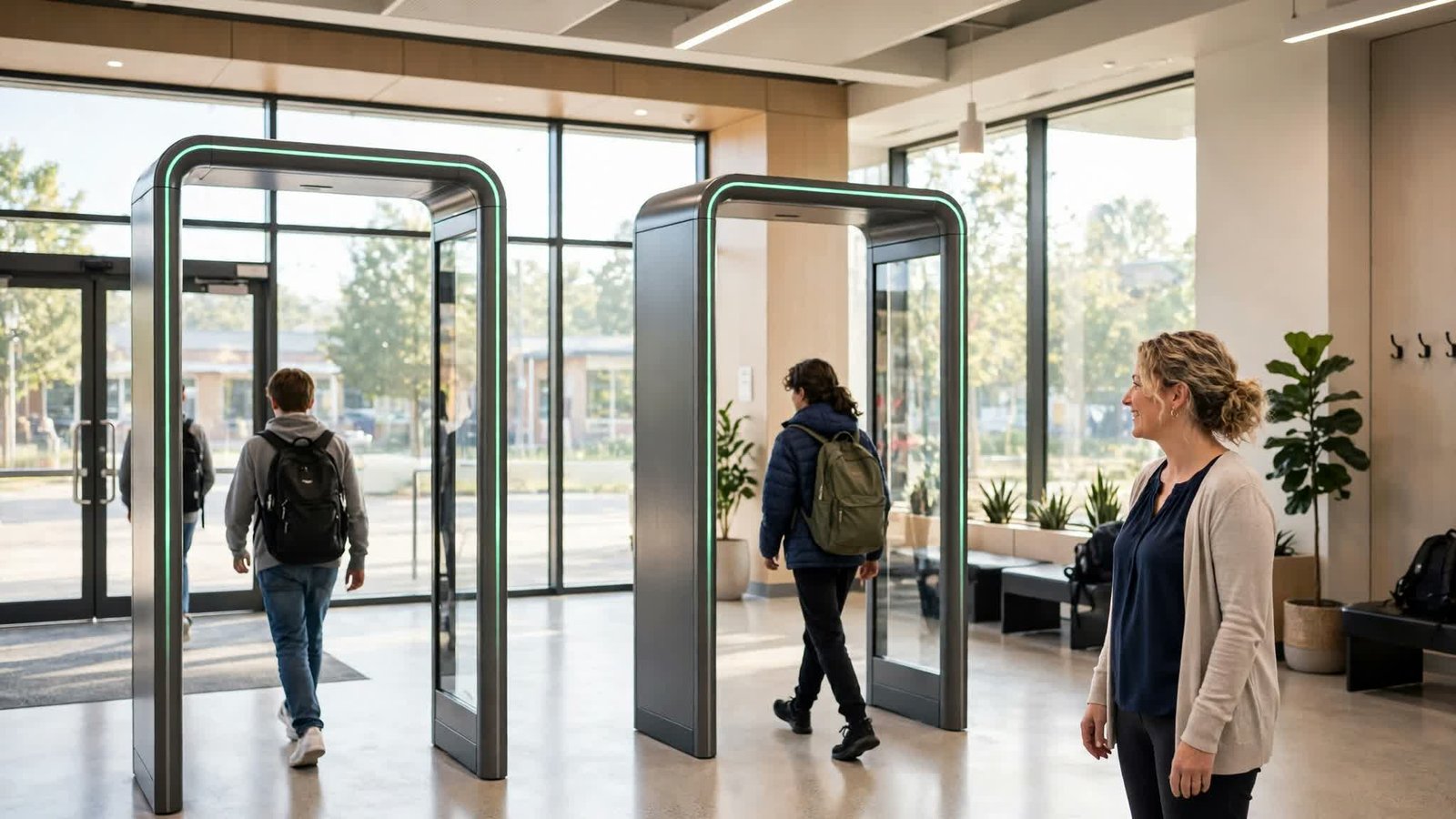
Weapons screening in schools used to mean metal detectors, emptied pockets and long lines at the front door. The newer generation — led by Evolv Technology and its Express lanes — uses sensor panels and AI software so students walk through at a normal pace, bags on shoulders, while it looks for objects with weapon-like characteristics. Anyone flagged steps aside for a secondary check by staff.
The appeal is obvious: screening happens before entry and covers concealed items cameras would miss. The limits are just as real. It protects only entrances fitted with lanes; every lane needs trained staff during the arrival window, and the morning rush limits how carefully each alert can be handled. A side door without a lane is not screened at all.

How camera-based AI gun detection works
The details differ by vendor, but the pipeline is much the same across the major platforms:
- Video is analyzed in real time. A computer-vision model trained on large libraries of firearm images scans each frame for gun shapes and how a person holds them.
- A possible match is clipped. When the model thinks it sees a firearm, it captures a clip or still image and sends it for review.
- A human verifies. At ZeroEyes, analysts in its operations center check the image before any alert goes out; Omnilert builds in a similar step. Vendors say the review takes seconds; it exists because raw AI alerts would include too many false alarms.
- Alerts go out with context. A verified detection is pushed to administrators, security staff and, in some setups, directly to local law enforcement — image and camera location attached, with integrations that can trigger PA announcements, mass notifications and lockdown workflows.
Performance rides on unglamorous details: camera resolution, mounting angle, lighting and distance. Low-resolution cameras aimed at bright doorways produce images far harder to judge than a vendor demo. Blind spots matter too. In January 2025, a student shot classmates in the cafeteria of Antioch High School in Tennessee. The school had an Omnilert system running, but according to news reports the gun was not visible to cameras before the shooting started — a stark illustration that detection coverage ends where camera coverage ends.
What AI weapon detection in schools costs: the honest picture
Vendors rarely publish prices, and districts that budget from a brochure number regret it. Costs vary widely by campus size, camera count and contract terms, so treat this section as a map of where the money goes — and get competing quotes before believing any of it.
Camera-based software is typically licensed per camera, per month or per year, so your total scales with a decision you control: how many cameras get the analytics. There is usually no major hardware purchase, but the quote is not the whole cost. Older cameras may need upgrading or repositioning before the AI can judge their images reliably; network capacity has to carry the streams; and the subscription renews, sometimes at a higher rate, every term.
Walk-through screening sits at the other end of the budget. The lanes are a major capital purchase — or a multi-year lease that amounts to the same thing — and a campus with several busy entrances may need several. The staffing line is bigger than most first quotes suggest: every lane needs operators for the full arrival window, plus space and personnel for secondary checks, every school day the system runs.
Compare quotes on total cost over the full contract — five years is a reasonable window — with licensing, hardware, installation, staffing, training, maintenance and renewals in one spreadsheet. Ask what is excluded, in writing. Many districts offset purchases with state or federal school-safety grants; availability changes by state and year, so treat a grant as a way to reduce the bill, not the reason to buy.
False alarms, privacy and the questions nobody markets
Every detection system lives on a dial. Turn sensitivity up and it catches more real weapons while flagging more harmless objects; turn it down and the reverse happens. No setting escapes the trade-off, and it is where marketing and reality part company.
In late 2024, the US Federal Trade Commission settled a case against Evolv, alleging the company had made claims about its scanners — detecting weapons while ignoring harmless items — that it could not substantiate. Evolv neither admitted nor denied the allegations. The settlement barred unsupported detection claims and gave certain school customers the right to cancel their contracts. The FTC’s complaint described scanners flagging laptops, binders and water bottles, and alleged that false alarms climbed steeply at higher sensitivity settings. The lesson: get performance numbers for the settings you will actually run, in buildings like yours.
Camera systems have their own documented false alarms. News reports have described students detained after AI flagged objects including a clarinet case and a bag of chips as possible guns. Each incident ended without a weapon, but not without a frightened student and a hard conversation with parents. Human verification cuts these errors down; it does not eliminate them. And the response protocol — who approaches the student, how, and with what information — is the district’s problem, not the vendor’s.
Privacy questions differ by type. Camera AI adds automated analysis to surveillance already recording; ask who can view flagged clips, how long images are kept, whether footage trains the vendor’s models, and where data is stored. Some vendors design around this: ZeroEyes says its verification staff see nothing until the AI flags a possible gun, so nobody watches students’ ordinary day. Screening lanes raise different questions: what record does a pass through the lane create for each student, and how long is it retained? Privacy advocates also raise a fair point about atmosphere. A building that screens every child every morning feels different from one that does not, and communities deserve a say before installation, not after.
Then there is the evidence question. Independent researchers examining this market — including a 2026 investigation by the science magazine Undark — note that little rigorous, independent research shows these systems prevent attacks, and that most published performance figures come from the vendors themselves. Early warning plainly has value — but buy measured performance on your own campus, not a promise.
10 questions districts should ask before buying
- What exactly does the system detect, and what does it miss by design — visible firearms only, concealed weapons, knives?
- What are the detection and false-alarm rates at the sensitivity settings you recommend for a school our size, and who measured them?
- Can we see independent test results, not just customer references you selected?
- How does human verification work — who reviews alerts, where are they based, and how long does detection-to-alert take?
- Which of our current cameras meet your requirements, and how many need replacing, moving or upgrading?
- What is the total cost over five years — licensing, hardware, installation, staffing, training, maintenance and renewals — in writing?
- What data is collected about students, where is it stored, how long is it kept, and is it used to train your models?
- How does the system connect to our mass notification, access control and local law enforcement, and who maintains those integrations?
- Can we pilot on one campus — on our cameras and our entrances — with success measures agreed in advance?
- If the system underperforms, what are our exit rights, and how are false alarms involving students handled and reviewed?
Where it fits in a layered safety plan
No single piece of school safety technology carries a campus. AI weapon detection systems earn their place as one layer among several — often not the first a district should fund.
The layers around it are mostly unglamorous: controlled entry points with working locks, a visitor-management process people actually follow, maintained cameras and lighting, an anonymous reporting channel students trust, threat-assessment teams that act on concerns early, counselors with manageable caseloads, and a mass-notification system. An alert that reaches adults who have never drilled what to do with it buys less time than the brochure implies.
For a deeper comparison of the platforms — features, verification models and how the vendors differ — see our guide to AI weapon detection software for schools. The comparison tells you what each system claims; the questions above tell you what to verify.

Frequently Asked Questions
Can AI weapon detection in schools find a concealed weapon?
Camera-based systems, no — they detect firearms visible to a camera. Walk-through screening is designed to flag concealed items, but performance depends on the sensitivity setting and the item, and no vendor can honestly promise to catch everything. Ask what the system is known to miss.
Does this replace security staff or school resource officers?
No — and a vendor who implies otherwise should worry you. Screening lanes need operators and staff for secondary checks; camera alerts need trained adults to respond. The technology changes what staff do — less watching monitors, more responding to verified alerts — but headcount rarely falls, and staffing is part of the real cost.
How accurate is AI weapon detection in schools?
There is no standard, independently run benchmark for this industry, which is why accuracy claims are so hard to compare. Vendors quote their own numbers, measured their own way. The useful figures come from your own pilot: detections and false alarms, at your settings, in your buildings, across a few months of ordinary school days.
What happens to the video and images the system collects?
It depends on the vendor and the contract, which is why the answer belongs in writing before you sign. Flagged clips are usually retained for review; routine-footage policies vary. Ask about retention, who can access it, whether it leaves your district’s control, and whether it trains the vendor’s models.
Can a district try a system before committing?
Usually, yes. Pilots are common in this market; a confident vendor should welcome one. Run it on your cameras and your busiest entrance, agree the success measures in writing first, and make sure the test period includes ordinary chaotic mornings — not just a quiet demo day.
The Bottom Line
AI weapon detection in schools is neither the breakthrough of the sales deck nor a gimmick. Camera-based AI can plausibly shave minutes off the time between a brandished gun and a response; screening lanes can raise the odds a weapon is stopped at the door. Both bring false alarms, recurring costs and privacy questions districts must manage openly. Districts that get value from school security technology buy it the boring way: pilot first, measure honestly, count the full cost, and fit it into a layered plan. The people, and the rehearsed response behind them, are the rest.


