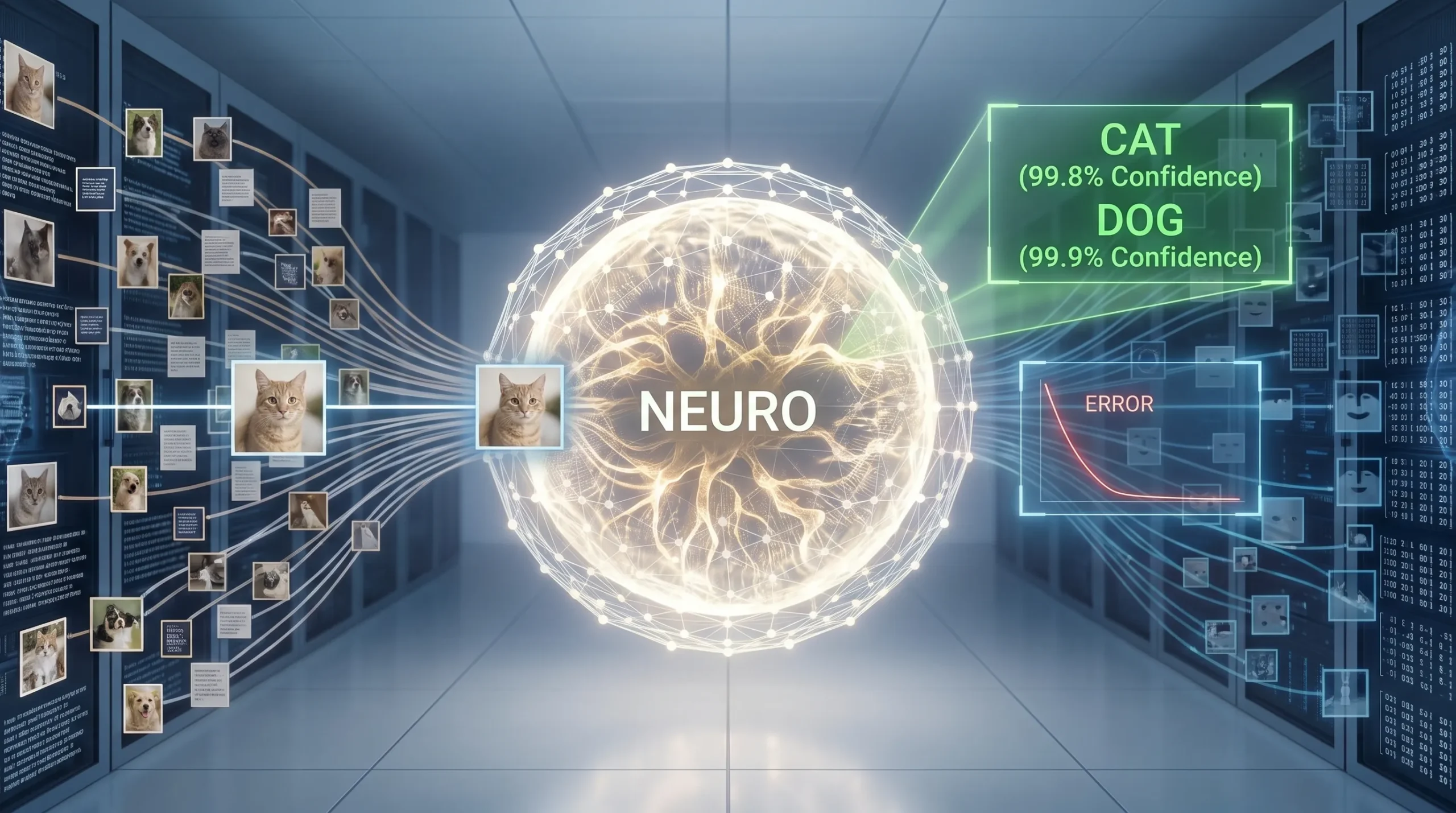
A common mistake is assuming AI understands data the way people do. How AI actually learns from data is less human and more mathematical: it finds patterns in examples, measures its mistakes, and adjusts internal numbers to improve future predictions.
Ask a system whether an image contains a cat, and the answer may appear instantly. Behind that answer, the model may perform millions or billions of numerical calculations involving pixels, weights, and probabilities. The process becomes clearer when you follow the full cycle: collect data, convert it into numbers, predict an outcome, measure error, update parameters, and test performance on new examples.
Artificial intelligence is the broad field. Machine learning is a method within AI that learns patterns from data. Deep learning uses neural networks with many layers. Training data supplies examples, parameters are the values learned during training, and a prediction is the model’s output for new input.
How AI Actually Learns From Data
AI doesn’t learn directly from a photo, webpage, spreadsheet, or conversation. Each source must become a numerical form that a model can process. The quality, coverage, and relevance of that data shape the patterns available to learn.
Training data determines which patterns are available
Training data contains examples of inputs and, in many cases, desired outputs. Labeled data supports supervised learning, while unlabeled data can support self-supervised or unsupervised learning. Reinforcement learning uses feedback, such as rewards or penalties, after an agent takes an action.
A narrow or outdated dataset can produce a model that fails in new settings. Missing values, duplicate records, noisy labels, biased sampling, and data leakage can all distort learning. Data leakage happens when information from the answer or future enters training by mistake, making results look better than they are.
Labels show what success means
A label gives the model a target. It might identify an image category, record a documented medical diagnosis, or show the known sale price of a house. People may create labels, software may generate them, or an existing business record may supply them.
Wrong or unclear labels teach the wrong lesson. If two annotators often disagree, the task may be subjective, or the labeling rules may need revision. A model cannot reliably exceed the quality of the signal it receives.
Raw information becomes numerical features
Images become pixel values. Text may become token IDs and embeddings, which are numerical vectors that capture learned relationships. Machines provide sensor readings, while tables provide columns such as age, location, or price.
Preprocessing can include scaling values, normalizing inputs, tokenizing text, removing duplicates, and handling missing fields. Ask what information each step preserves and what it discards. Removing timing, location, or other key context can limit the model before training starts.
Models Learn by Adjusting Parameters to Reduce Error

A model begins with parameters, often set to small random values or inherited from earlier training. It makes a prediction, compares that prediction with a target, calculates a loss, and changes its parameters. Google’s Machine Learning Crash Course teaches this cycle through regression, classification, loss, gradient descent, and evaluation.
Parameters are adjustable settings
Parameters are numerical values learned from examples. In a simple model, weights control how strongly each input affects the result. Modern neural networks contain many interacting weights, so their learned patterns are far more complex than a short list of human rules.
Hyperparameters are different. Developers choose them before or during training, including the learning rate, batch size, model architecture, and training duration. Parameters come from data; hyperparameters guide the process that learns them.
Loss turns mistakes into a signal
A loss function assigns a number to the model’s error. Mean squared error is common for many regression tasks, while cross-entropy is common for classification. Language and ranking systems may use objectives designed for their particular tasks.
Lower training loss means the model fits its training objective better. It doesn’t prove the system will work well outside that dataset. A model can reduce training loss by memorizing noise.
Gradient descent makes small updates
During training, the system selects a batch of examples, calculates predictions, measures loss, and estimates how each parameter affected that loss. Backpropagation calculates these effects efficiently through the network. Gradient descent then updates parameters in the direction expected to reduce error.
Training curves reveal more than one accuracy number. If training loss falls while validation loss rises, the model may be overfitting. Validation metrics, error rates, and subgroup results show whether progress is useful.
Different Learning Methods Teach AI in Different Ways
Learning depends on the feedback signal. A model may receive known answers, create targets from raw data, or discover better actions through rewards. These approaches solve different types of problems.
Supervised learning connects inputs to answers
Supervised learning uses input-output pairs. Classification predicts categories, such as spam or not spam. Regression predicts a number, such as a house price, credit-risk score, or weather value.
The model learns a relationship between examples and targets. It does not receive a full explanation of why each answer is correct. It learns whatever patterns help lower the chosen loss.
Self-supervised learning creates its own targets
Self-supervised systems form tasks from the data itself. A language model may predict the next token or fill a masked part of a sentence. An image system may reconstruct hidden parts of an image.
This approach allows training on large collections without manually labeling every example. Next-token prediction teaches statistical relationships among words and symbols, but it doesn’t guarantee factual accuracy, reasoning, or human-like understanding.
Reinforcement learning learns from outcomes
In reinforcement learning, an agent takes actions in an environment and receives rewards or penalties. It updates its strategy based on those outcomes. Game-playing systems and robotics research use this setup.
The correct action is usually not handed to the system, as it is in supervised learning. Delayed rewards, exploration, safety limits, and poorly designed reward functions can make training difficult.
Generalization Determines Whether Learning Works
The goal is performance on unseen data, not perfect memory of training examples. Underfitting means the model misses useful patterns. Good generalization means it works across new examples. Overfitting means it learns quirks or noise that do not transfer.
Data splits prevent false confidence
Training data fits the parameters. Validation data helps choose the model, features, and hyperparameters. A test set provides a final estimate using examples that stayed separate during development.
Repeatedly changing the system after checking the test set weakens that separation. Time-based splits help with changing conditions, group-based splits prevent related records from crossing sets, and stratified splits preserve important class proportions when appropriate.
Overfitting rewards memorization
A model may score better on training examples while performing worse on validation examples. That pattern suggests it has learned details specific to the training set.
Teams can reduce overfitting by collecting better data, limiting model complexity, adding regularization, using dropout where suitable, stopping early, augmenting images, and selecting features with care.
Metrics show different kinds of success
Accuracy can hide poor results when one class is much more common than another. Precision measures how often positive predictions are correct, while recall measures how many real positives the system finds. F1 score, confusion matrices, mean absolute error, and calibration answer different questions.
Define the cost of false positives and false negatives before choosing a metric. Also check results across relevant demographic groups, regions, time periods, error types, and operating conditions. Aggregate scores can hide serious failures.
Model Architecture Shapes What AI Can Capture

Architecture controls how a model processes information. A suitable design matches the structure of the task, so image, text, audio, and table problems may need different approaches.
Neural networks build layered representations
Each layer transforms its input into a new representation. In image tasks, early layers may detect local edges or color changes, while later layers combine those signals into larger shapes. In text tasks, learned representations capture relationships among tokens.
These features are learned during optimization rather than written as a manual checklist. People still choose the architecture, objective, data pipeline, and evaluation plan.
Convolutional networks find local visual patterns
Convolutional neural networks use filters that scan across nearby pixels. Sharing those filters across positions helps the network detect the same local structure in different parts of an image. This design has been useful for image classification and object detection.
Stanford’s CNN course material shows how image inputs pass through layers into class probabilities, with parameters learned through backpropagation.
Transformers weigh relationships in sequences
Attention lets a model assign different weights to relationships among elements in a sequence. Transformers now support systems for language, vision, audio, and combined data types.
Attention patterns do not automatically explain a model’s full reasoning. Context limits, computing costs, hallucinations, and sensitivity to training data still require careful testing.
Data and Human Choices Shape Final Behavior
Model behavior comes from more than an algorithm. Data sources, labeling rules, objectives, deployment feedback, and monitoring all affect the final system.
Bias can enter before training
Historical records may contain unequal treatment. Sampling may leave out groups, measurement tools may work differently across settings, and labelers may apply inconsistent judgments. These data problems can interact with model design and produce unequal errors.
Document sources, collection dates, known gaps, exclusions, and labeling rules. The NIST AI Risk Management Framework offers voluntary guidance for managing risks during AI design, development, use, and evaluation.
Objectives can reward the wrong behavior
A model optimizes the target it receives, not the wider human goal. A vision system may use background clues instead of the intended object. An engagement score may reward attention while reducing information quality.
These failures can come from proxy metrics, reward hacking, or shortcut learning. Better objectives and tests help reveal whether the model learned the intended signal.
Deployment changes the data
Real-world inputs shift as users, policies, markets, and operating conditions change. Concept drift occurs when the relationship between inputs and outcomes changes. Feedback loops can also shape future data when people respond to the model’s decisions.
Post-deployment checks should track performance, data drift, subgroup results, incidents, human escalations, and retraining criteria. Version control makes it possible to identify which model and data produced a decision.
Conclusion
AI learns by turning data into numerical representations, producing predictions, measuring loss, and updating parameters through optimization. Validation tests whether those patterns work on unseen examples, while deployment reveals new conditions the training set may not cover.
Data quality controls which patterns are available. Labels and objectives define the feedback signal. Architecture shapes which relationships the model can capture. Evaluation must match real decisions and affected groups.
AI can find complex statistical patterns and produce useful predictions without possessing human understanding by default. Reliable results require representative data, clear goals, relevant tests, honest limits, and ongoing monitoring. When you assess an AI system, start with its data and feedback loop, not its fluent output.
FAQS
AI examines many examples, detects repeated relationships, and adjusts its internal settings when its predictions are wrong. After enough training, it uses those learned patterns to estimate outcomes for new information.
AI needs data that is relevant, sufficiently varied, and reasonably accurate for the task. Clean and representative data helps the model learn useful patterns instead of picking up errors, gaps, or misleading signals.
The system compares its answer with the expected result and calculates the difference, often called an error or loss. Training algorithms then modify the model’s parameters to reduce similar mistakes in future examples.
Training teaches the model using examples, validation helps fine-tune its settings, and testing checks how well it performs on data it has not previously seen. Separating these stages helps reveal whether the model truly learned or simply memorized its practice data.
Yes. Predictions can fail when the new data differs from the training examples, important information is missing, or the original data contains bias. AI outputs should therefore be evaluated with suitable performance checks and human judgment, especially in important decisions.


One Comment on “How AI Learns From Data to Make Better Predictions”
Comments are closed.